How to Shock a Pool (the Right Way)
How to shock a pool the right way: which shock to use, how much, why to do it…
Read more →
A dirty filter is behind more cloudy Florida pools than bad chemistry — because a choked filter can’t clear the water no matter how perfect the chlorine is. The good news: cleaning it is a straightforward job once you know your filter type and the one number that tells you when. This guide covers the three filter types Florida pools use, how to clean each, when to do it (hint: watch the pressure gauge, not the calendar), and why our pollen and storms mean cleaning more often than the manual says.
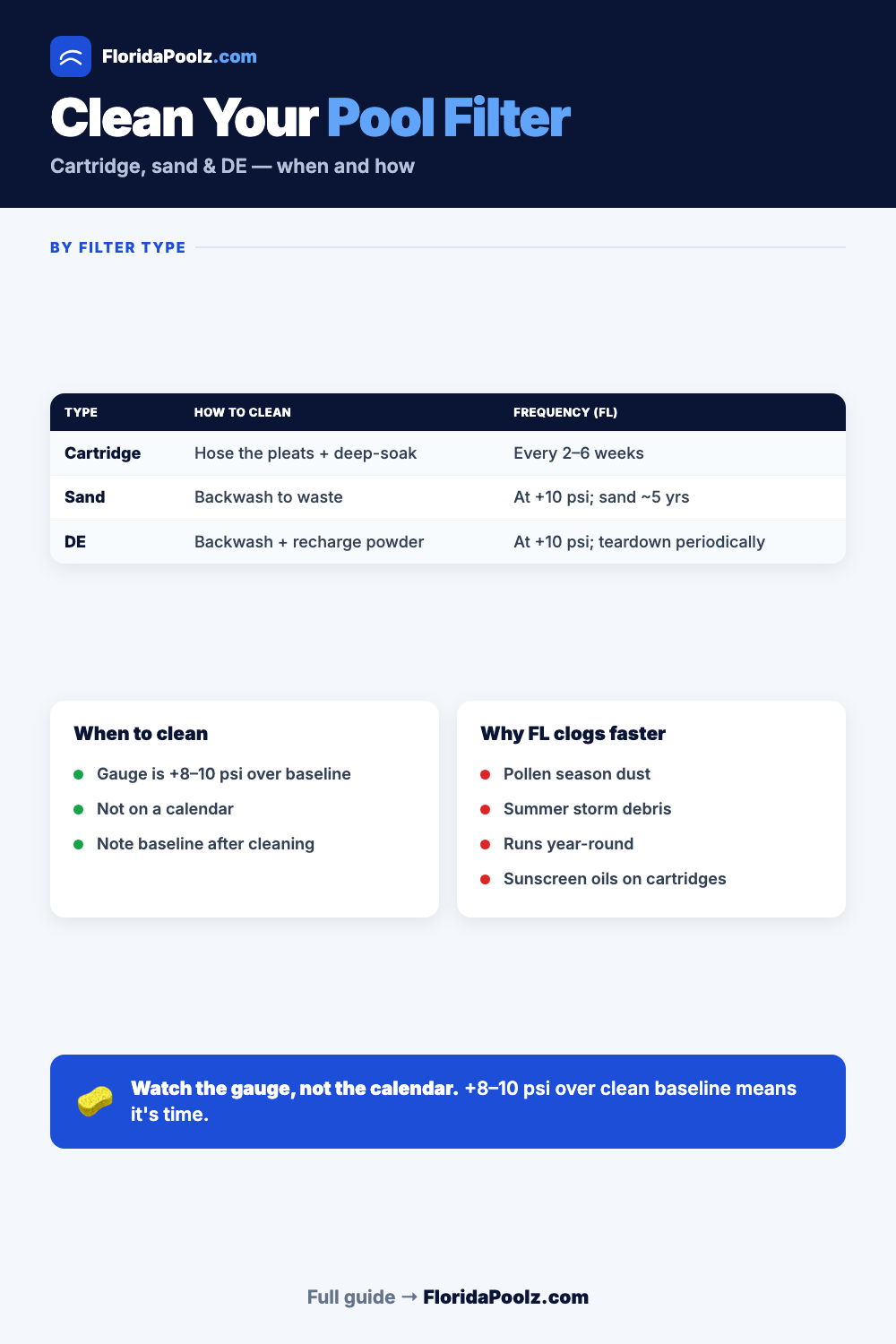
Forget the calendar. Every pool filter has a pressure gauge, and the rule is the same across all types: clean the filter when the gauge reads 8–10 psi above its clean baseline. A clean filter runs at a steady “normal” pressure; as it traps debris, flow drops and pressure climbs. When it’s ~10 psi over baseline, water is barely moving through it, and it’s time. Note your baseline right after a cleaning so you know your target. In Florida, pollen bursts and post-storm debris can push you to that threshold far faster than the “every few months” national guidance — sometimes weekly during pollen season.
| Type | How you clean it | Frequency (FL) |
|---|---|---|
| Cartridge | Remove + hose off the pleats; deep-soak periodically | Every 2–6 weeks; media lasts 1–3 yrs |
| Sand | Backwash (reverse flow to waste) | When +10 psi; change sand every ~5 yrs |
| DE (diatomaceous earth) | Backwash, then recharge with fresh DE | When +10 psi; full teardown periodically |
Not sure which you have? Cartridge filters are a tall canister you open to pull out pleated elements. Sand and DE filters usually have a multiport valve on top or side with a “backwash” setting. DE uses a fine white powder you add after backwashing; sand doesn’t. Each cleans differently, so start by identifying yours.
The most common Florida setup, and the most hands-on:
Pro move: own a second set of cartridges. Swap the clean set in, take the dirty set to clean at your leisure, and the pool’s never down. Cheap insurance for a few minutes saved each time.
Backwashing sends water to waste, so you’ll top the pool off after — mind that fresh Florida fill water can shift your chemistry and adds calcium. Sand itself lasts around five years before it needs replacing; when backwashing stops restoring pressure, the sand is worn.
DE filters filter the finest and take the most work. The routine mirrors sand — backwash to flush the old DE-and-debris coating — but then you must recharge by adding the correct amount of fresh DE powder through the skimmer with the pump running, which re-coats the internal grids. Periodically the filter needs a full teardown to hose the grids by hand, since backwashing alone leaves old DE caked in over time. DE gives the clearest water of the three, at the cost of the most maintenance — a fair trade for owners who want glass-clear water.
National “clean every three months” advice assumes a filter that isn’t under Florida’s specific loads:
So watch the gauge, not the calendar — a Florida filter may need attention every couple of weeks in peak season and rarely in winter.
If the pressure won’t drop back to baseline after a proper cleaning, or the water stays cloudy with clean chemistry and a clean filter, the media is likely at the end of its life (worn sand, matted cartridges, caked DE grids) or the filter is undersized for the pool. A filter that can’t keep a Florida pool clear even with good care is worth a professional look — sometimes the fix is fresh media, sometimes a bigger filter. A pump-and-filter that keeps losing the clarity battle is an equipment problem, not a chemistry one; our cloudy water guide helps tell them apart, and licensed Florida pool techs can size or service the system.
Go by the pressure gauge, not the calendar: clean when it reads 8–10 psi above its clean baseline. In Florida that can be every couple of weeks during pollen season or after storms, and less often in winter. Cartridge media lasts 1–3 years, sand about 5, before replacement.
Cartridge filters you remove and hose off (with periodic deep-soaks); sand and DE filters you backwash via the multiport valve. DE also needs recharging with fresh powder after each backwash. Cartridge is the most common Florida setup; DE gives the clearest water but the most work.
Avoid household bleach and detergents — they can degrade the cartridge media and leave residue that foams the pool. Use a dedicated filter-cleaning solution for the periodic deep-soak, and a plain hose rinse for routine cleaning. For sunscreen oil buildup, the soak is what a rinse can’t replace.
If chemistry is balanced and the filter is genuinely clean but pressure won’t return to baseline, the media may be worn out or the filter undersized for the pool. A filter that can’t keep a Florida pool clear even with good care is an equipment issue worth a professional assessment.
Yes — backwashing (sand and DE) sends water to waste, so you’ll top the pool off afterward. Keep in mind Florida fill water adds calcium and can shift your chemistry, so retest and rebalance after a big top-off. Cartridge cleaning doesn’t waste pool water this way.

We build Florida's pool contractor directory from county permit records, DBPR license data, and verified Google reviews — and write these guides from the same data, with input from the licensed builders and service pros listed on the site.
Straight-talking, Florida-specific help — written from permit data and local pros.
How to shock a pool the right way: which shock to use, how much, why to do it…
Read more →
A Florida pool maintenance schedule that actually fits the climate: daily, weekly, monthly, and seasonal tasks, why our…
Read more →
How to prepare a pool for a hurricane in Florida: the before-storm checklist, the drain mistake that wrecks…
Read more →