The Pool Maintenance Schedule That Fits Florida
A Florida pool maintenance schedule that actually fits the climate: daily, weekly, monthly, and seasonal tasks, why our…
Read more →
Shocking a pool means adding a big, deliberate dose of chlorine to burn through the stuff your normal chlorine level can’t keep up with — dead organics, sweat and sunscreen, the start of an algae bloom, that cloudy look after a party or a storm. Done right, it resets the water overnight. Done wrong, it clouds the pool, bleaches a vinyl liner, or barely does anything because the timing was off. Here’s how to shock a pool properly in Florida: which product, how much, when, and the mistakes to skip.
Your everyday chlorine handles the routine sanitizing load. But chlorine also gets “used up” combining with contaminants into weak, spent compounds (chloramines — the stuff that actually causes the harsh chlorine smell, ironically a sign of too little effective chlorine, not too much). Shocking floods the water with enough chlorine to oxidize all that spent load and kill anything growing, then settles back down. It’s a reset, not a routine — you shock when the water needs rescuing, not every week for its own sake.
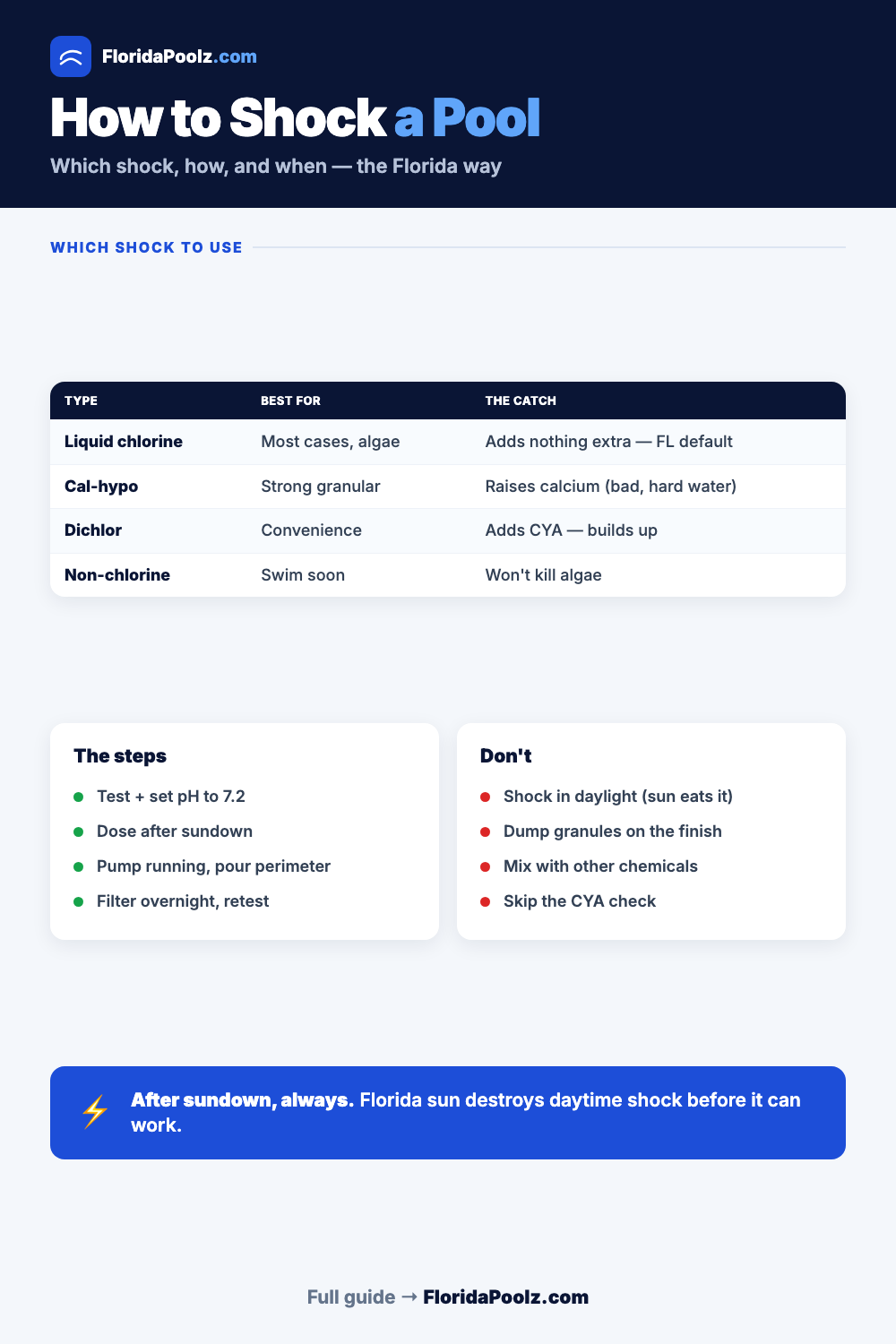
| Type | Best for | The catch |
|---|---|---|
| Liquid chlorine (sodium hypochlorite) | Most situations, algae fights | Adds nothing extra; bulky to store; the pro favorite |
| Cal-hypo (calcium hypochlorite) | Strong granular shock | Raises calcium hardness every time — bad for hard FL water |
| Dichlor (granular, stabilized) | Convenience | Adds CYA (stabilizer) — builds up like tablets do |
| Non-chlorine (MPS/oxidizer) | Quick oxidize, swim soon | Doesn’t kill algae; a supplement, not a rescue |
For Florida, liquid chlorine is usually the smart default: it shocks hard, kills algae, and adds no calcium or stabilizer to accumulate. Cal-hypo is potent but drives up calcium hardness — a real problem in our hard-water regions where calcium clouding is already a risk. Dichlor’s added stabilizer stacks up the same way trichlor tablets do. Use those knowingly, not by default.
The honest answer: it depends on your pool volume and why you’re shocking. A routine “refresh” shock is a moderate dose; killing an algae bloom takes far more, held for days. The key number people miss is that your cyanuric acid level sets your target — at high CYA, it takes dramatically more chlorine to reach an effective shock level (the ratio math is in the cyanuric acid guide, and the full kill process is in the algae guide). Follow the product’s dosing for your gallonage as a starting point, test, and re-dose if needed. When in doubt, it’s safer to dose to a known target and retest than to dump a guess.
A pool frequently goes cloudier for a day after a big shock — that’s the chlorine oxidizing dissolved gunk into particles the filter then clears, plus dead algae if you were fighting a bloom. Keep the filter running and it typically clears within 24–48 hours. The two exceptions: a white haze that appears instantly points to calcium (common with cal-hypo in hard water), and a green cast that persists can be dissolved copper reacting to the chlorine, not algae — our green pool guide sorts out which.
Only when the water needs it — there’s no fixed “shock every week” rule for a well-maintained pool. In practice a Florida pool gets shocked after big rains, heavy use, or when clarity slips, which in peak summer might be every couple of weeks and in winter rarely. If you find yourself shocking constantly, that’s a signal something underlying is off — usually high CYA throttling your everyday chlorine, or a pump not running enough hours. Fix the cause and the need to shock drops. If chasing it gets old, a weekly service keeps the water balanced so shocks become rare. Find licensed Florida pool pros in the directory.
After sundown, every time. Florida’s intense UV destroys a large share of chlorine before it can work if you shock during the day, so evening dosing lets the chlorine spend the whole night oxidizing and killing. It’s the single most important timing rule for shocking here.
Liquid chlorine is the smart Florida default — it shocks hard, kills algae, and adds no calcium or stabilizer to build up. Cal-hypo raises calcium hardness (bad for hard water), and dichlor adds cyanuric acid that accumulates like tablets. Use those two knowingly, not by default.
Wait until free chlorine drops back to a safe 1–5 ppm, which is usually the next day after an overnight shock. Always test before anyone gets in — swimming in freshly shocked, high-chlorine water can irritate skin and eyes and damage swimwear.
Usually normal — the shock oxidized dissolved material (and any dead algae) into particles the filter needs a day or two to clear, so run the pump continuously. If the haze appeared instantly it’s likely calcium from cal-hypo; if it’s a persistent green tint it may be copper, not algae.
It depends on your pool volume and the reason — a refresh needs a moderate dose, an algae kill needs much more held for days. In practice, high cyanuric acid raises the dose required to reach an effective level. Follow the product’s dosing for your gallonage, test, and re-dose rather than guessing.

We build Florida's pool contractor directory from county permit records, DBPR license data, and verified Google reviews — and write these guides from the same data, with input from the licensed builders and service pros listed on the site.
Straight-talking, Florida-specific help — written from permit data and local pros.
A Florida pool maintenance schedule that actually fits the climate: daily, weekly, monthly, and seasonal tasks, why our…
Read more →
How to prepare a pool for a hurricane in Florida: the before-storm checklist, the drain mistake that wrecks…
Read more →
How to test pool water in Florida: strips vs kits, what to test and how often, how to…
Read more →