Pool Cage & Screen Enclosure Cost in Florida (2026)
Pool cage cost in Florida: new enclosure prices per sq ft, rescreen vs re-cage, panel repair, hurricane-code impact,…
Read more →Florida pool fence law is set by the Residential Swimming Pool Safety Act (Florida Statutes Chapter 515), and it’s stricter than most new pool owners expect — for a sobering reason. Florida leads the nation in child drownings, and the law exists to put a barrier between a curious toddler and the water. The good news: the law gives you four ways to comply, not one, so there’s a path that fits almost any yard. Here’s what’s required, whether your screen cage counts, and what happens at a home sale.
This is a plain-English guide, not legal advice — confirm specifics with your county building department, since local codes can add to the state minimum.
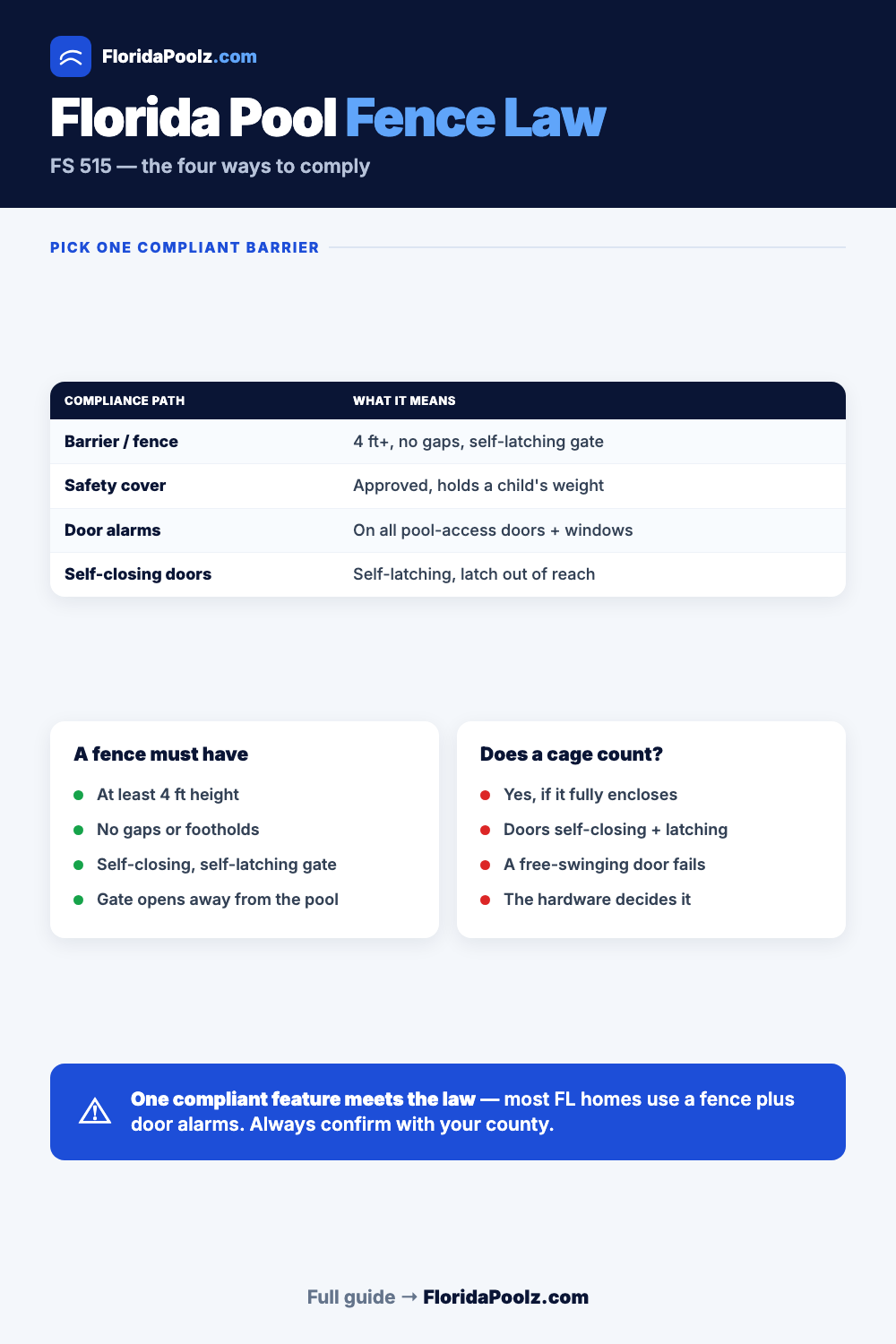
FS 515 requires a new residential pool to have at least one of these safety features. You don’t need all four — one compliant barrier satisfies the law:
Most Florida homes use a fence or barrier, often combined with door alarms for the house-to-pool doors — but legally, one qualifying feature is the minimum.
If you go the barrier route (most do), the fence has to actually stop a small child, so the spec matters:
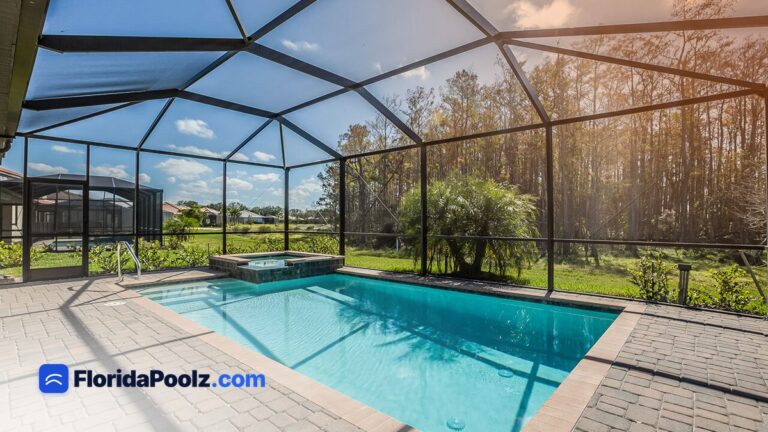
This is the most-asked Florida question, and the answer is yes, with conditions. A screen enclosure (pool cage) can serve as the barrier if it meets the barrier requirements — meaning the door from the house into the cage, and any cage door to the yard, must be self-closing and self-latching, and the cage must fully enclose the pool. A cage with a screen door that just swings freely does not comply. Because nearly every Florida pool has a screen cage, this is usually the practical path — but the door hardware is what makes or breaks compliance, so don’t assume the cage alone is enough.
Non-compliance is a second-degree misdemeanor under the statute — but the fines are the small risk. The real exposure is civil liability and tragedy: an unfenced pool where a child is hurt is both a legal catastrophe and a lifelong one. Insurers also care; some policies require a compliant barrier, and a claim involving a non-compliant pool can be contested. Treat the barrier as non-negotiable, not a box to check.
The law applies most clearly to pools built after October 2000, but the safety principle reaches everyone:
The law reads strict because the stakes are. Drowning is a leading cause of death for young children in Florida, and it happens fast and silently — not with the splashing and shouting people imagine, but in under a minute, often in a pool the child reached through an unlatched door while an adult was steps away. A barrier isn’t bureaucratic box-ticking; it’s the layer that buys the seconds a distracted moment takes away. Every requirement in FS 515 traces back to that reality, which is why the smart approach is layers, not the legal minimum — a fence and door alarms and the habit of watching, because any single layer can fail.
If your compliance path leans on alarms — common when the house wall doubles as part of the pool barrier — the spec matters. Approved exit alarms go on every door and window with direct access to the pool area, they must sound loudly enough to be heard through the house, and they need a momentary bypass switch mounted high (out of a child’s reach) so adults can pass through without disabling the system permanently. The failure mode to avoid is the alarm that gets switched off “just for today” and never switched back — which is exactly how the tragedies happen. Alarms are a strong second layer; leaning on them as the only layer asks a lot of a device someone has to keep armed.
An approved safety pool cover can satisfy the law on its own, but “safety cover” has a specific meaning: a cover engineered and rated to hold a child’s (and ideally an adult’s) weight without letting them slip underneath, anchored taut across the pool — not a flimsy solar blanket or a leaf tarp, which a child can slide beneath and drown under, out of sight. Motorized and manual track-mounted safety covers both qualify when they meet the standard. They’re popular for owners who want the pool fully sealed when unused, though in a screened Florida pool most people find a compliant cage plus door hardware the simpler route.
For a new build, compliance is the builder’s job and it’s designed in from the plans — the permit won’t close without it. This is one reason to hire a licensed builder who knows your county’s interpretation; a good one treats the barrier as part of the design, not an add-on. For an older pool that predates the current act, you’re not automatically forced to upgrade — but you’re also not protected by grandfathering in the ways that matter: insurers can still require a barrier, a renovation permit can trigger current code, and the safety risk is identical to a new pool’s. Retrofitting an older pool to modern barrier standards — adding a compliant fence, upgrading gate hardware, fitting door alarms — is usually straightforward and inexpensive relative to the risk it removes. If you’ve just bought a home with an older pool, treat it as one of the first jobs, not a someday item.
Beyond the statute’s own penalty, two financial realities make compliance non-negotiable. First, homeowner’s insurance: many Florida policies require a compliant pool barrier as a condition of coverage, and a claim tied to a non-compliant pool — especially one involving injury — can be reduced or contested. Read your policy’s pool language, and if it requires a barrier, make sure yours actually meets it. Second, civil liability: an unfenced or improperly fenced pool where someone (a neighbor’s child, a guest) is hurt exposes the owner to lawsuits that dwarf the cost of any fence. The “attractive nuisance” doctrine means a pool is treated as something that predictably draws children, raising the owner’s duty to secure it. A few hundred to a few thousand dollars of barrier is cheap insurance against a life-altering claim.
FS 515 is the statewide floor, but Florida’s counties and municipalities administer building code locally and some add requirements on top — stricter gate-latch heights, specific alarm standards, or additional inspection steps for the barrier at final. That’s why “confirm with your county building department” isn’t a throwaway line: two neighbors in different counties can face slightly different specifics. Before you build a fence or rely on a cage, a five-minute call to the local building department confirms exactly what passes inspection in your jurisdiction — and saves the cost of building something that has to be redone.
A licensed pool builder or fence contractor designs compliance into a new build automatically, and your county building department is the authority on local specifics — always confirm with them, since counties can exceed the state minimum. If you’re building, ask your contractor exactly how the plan meets FS 515 (it’s one of the questions worth asking before you sign). Find licensed Florida pool and enclosure pros in the directory.
Before you consider the pool “secured,” walk this list — it’s the practical version of FS 515 for a Florida yard:
Run it seasonally, not once. Gate springs wear out, latches loosen, and alarms get disarmed and forgotten — the barrier that passed inspection three years ago may not be doing its job today.
Under FS 515, a residential pool needs at least one approved safety feature: a compliant barrier/fence, an approved safety cover, exit alarms on pool-access doors and windows, or self-closing self-latching devices on those doors. One qualifying feature meets the law; most owners use a fence plus door alarms.
At least 4 feet high, with no gaps a small child can pass through and no footholds to climb, plus a self-closing, self-latching gate that opens away from the pool with the latch out of a child’s reach. Counties can require more, so confirm locally.
It can, if it meets the barrier requirements — the cage must fully enclose the pool and the doors (house-to-cage and cage-to-yard) must be self-closing and self-latching. A cage with a freely swinging screen door doesn’t comply. The door hardware is the deciding factor.
Pools built after October 2000 fall squarely under the current act; older pools may pre-date it. But the safety risk is the same, insurers may require a barrier, and a major renovation permit or a home sale can trigger a requirement to meet current code. Bringing an old pool up to standard is strongly advised.
It’s a second-degree misdemeanor under the statute, but the fine is the minor risk — the real exposure is civil liability and the tragedy of a child drowning. Some insurance policies also require compliance. Treat a proper barrier as essential, not optional.

We build Florida's pool contractor directory from county permit records, DBPR license data, and verified Google reviews — and write these guides from the same data, with input from the licensed builders and service pros listed on the site.
Straight-talking, Florida-specific help — written from permit data and local pros.
Pool cage cost in Florida: new enclosure prices per sq ft, rescreen vs re-cage, panel repair, hurricane-code impact,…
Read more →
How long does it take to build a pool in Florida - by type, stage by stage, and…
Read more →
Pool resurfacing cost in Florida by finish - marcite, quartz, pebble, tile - plus what a resurface includes,…
Read more →