How to Test Pool Water (and Read the Results Like a Tech)
How to test pool water in Florida: strips vs kits, what to test and how often, how to…
Read more →
When a hurricane is bearing down, your pool needs about thirty minutes of the right preparation — and it needs you to not do the one thing everyone’s tempted to do. The short version: leave the water in, balance the chemistry a little high, stow every loose object, cut power to the equipment, and leave the screen cage alone. Then after the storm, restore power safely, clear the debris, shock it, and run the filter hard. Do that and your pool rides out the storm as a giant, well-behaved rain barrel. Get the water-level part wrong and you can end up with a five-figure repair.
Here’s the full Florida playbook — before, during, and after — including the mistakes that turn a survivable storm into an expensive one.
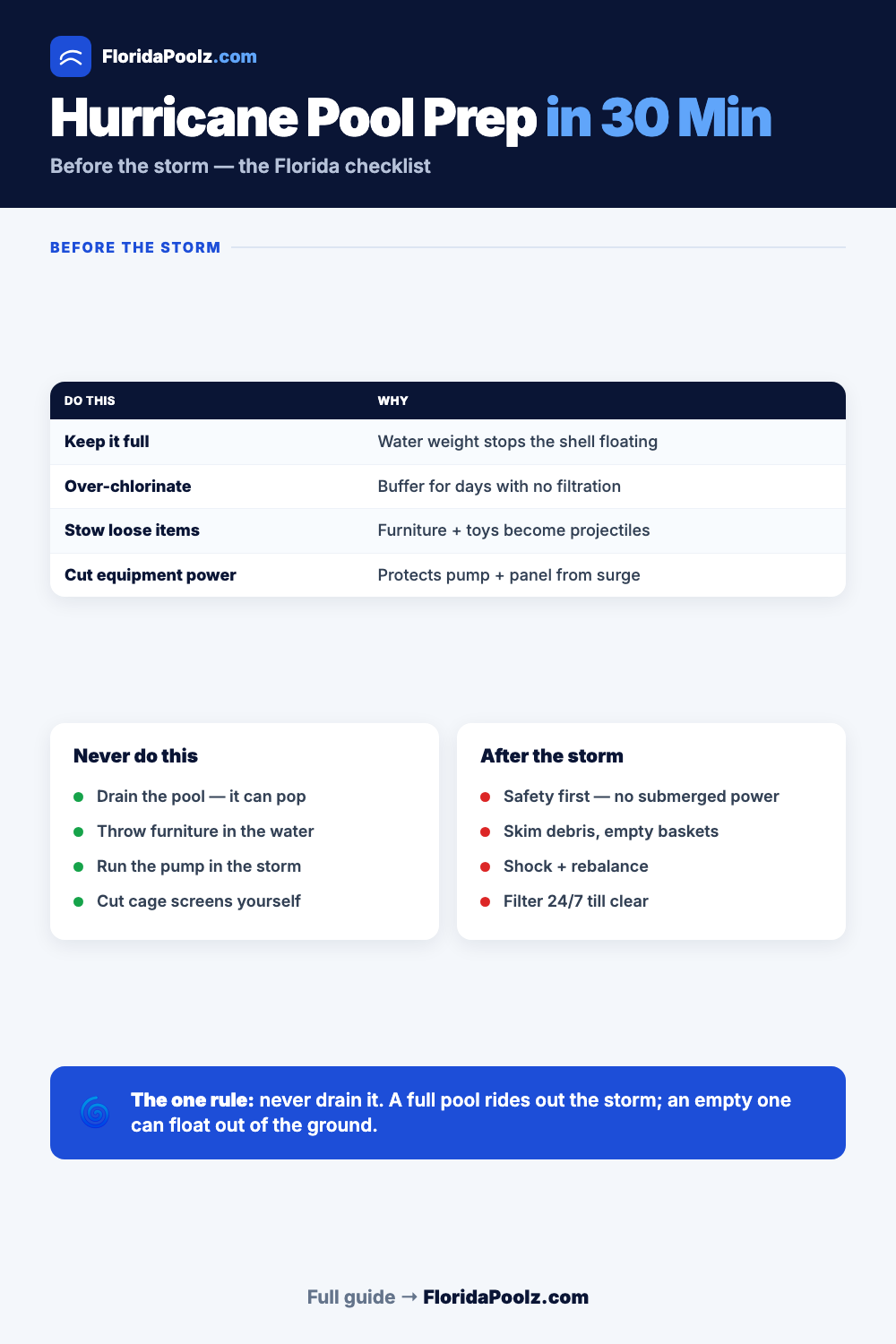
Every hurricane season, someone drains their pool “so it won’t overflow.” It’s the single worst thing you can do, and here’s why: an empty or low pool loses the downward weight of its water at exactly the moment the ground around it is saturated. Florida’s high water table rises fast in a storm, and that groundwater pushes up on the shell with enormous force. A full pool’s weight holds it in place; a drained one can float up out of the ground — “pool pop” — cracking the shell, snapping plumbing, and heaving the deck. It’s one of the most expensive pool disasters there is, and it’s entirely self-inflicted.
So the rule is simple: keep the pool full. A pool overflowing by a few inches of rainwater is a non-event — it drains back down on its own. A drained pool during a flood is a catastrophe. If you’re truly worried about heavy overflow near the house, lower the level by a foot at most, never more, and never empty it.
Per above — full is safe. If your pool sits right against the house and you fear overflow toward the foundation, drop it no more than 12 inches below the tile line. That’s enough to absorb heavy rain without removing the ballast that keeps the shell down. Most Florida pool pros simply leave it full.
You’re about to lose power (so no filtration) and gain a flood of rainwater and debris (which dilutes chlorine and feeds algae). Get ahead of it: balance the water and add an extra dose of chlorine before the storm, pushing free chlorine to the high end of normal or a touch above. This buffer helps the pool resist turning green during the days it may sit without circulation. Don’t overdo it to the point of bleaching, but a strong pre-storm chlorine level is cheap insurance against a post-storm swamp.
In hurricane-force wind, patio furniture, planters, pool toys, solar covers, and cleaning poles become projectiles that break windows and tear screens. Bring inside, or secure, everything that isn’t bolted down: chairs, tables, umbrellas (and umbrella bases), floats, the pool cleaner, skimmer nets, and any decor. Do NOT throw furniture into the pool “to protect it” — heavy items can crack the finish or damage the shell, and lighter ones just become underwater debris. The pool is not a storage bin.
Your pump, heater, and control panel are the most flood-and-surge-vulnerable parts. Steps that matter:
Homeowners ask whether to remove cage screens so wind passes through. For most storms, leave the cage alone — modern enclosures are engineered to a wind-load spec, and a properly built cage is designed to either hold or fail predictably. Cutting screens yourself rarely helps and voids the engineering. The exception is guidance from your builder or county for an extreme (Category 4–5) event; follow local advice, not internet folklore. If a cage is going to go, there’s little a homeowner can do in the final hours except stay away from it.
There’s nothing to do during the storm except stay safe and away from the pool and its equipment. Power will likely go out; that’s fine — a balanced, over-chlorinated pool sits stable for days without circulation. Don’t venture out to “check on it” in the wind. The pool is the least of your concerns while it’s blowing.
Once it’s genuinely safe to go outside, the pool recovery runs in a specific order — safety first, always.
Treat every downed line as live and every flooded area as electrified until proven otherwise. Do not restore power to the pool equipment if it was submerged — flooded motors and panels need a professional to inspect and dry out before re-energizing, or you risk electrocution and fire. If in doubt, leave the breaker off and call a pro.
Skim and net out leaves, branches, and whatever the wind delivered. Empty the skimmer and pump baskets. Get the big organic load out fast — it’s actively consuming your chlorine and staining the finish the longer it sits. For a heavy debris load, a leaf rake and patience beat trying to vacuum branches through the system.
With the equipment checked and dry, restore power and run the pump continuously to start turning the water over. If the pump was flooded or won’t prime, stop and get it looked at rather than forcing it. Circulation is what pulls the pool back from the brink.
The storm diluted your chlorine and dumped in nutrients, so the water is primed to bloom. Test, then shock the pool to knock back whatever started growing, and rebalance pH and alkalinity, which the rainwater will have shifted. Expect the water to be cloudy for a day or two as the filter clears the storm load — that’s normal recovery, and our cloudy water guide covers clearing it.
Run the pump around the clock until the water clears, and clean the filter whenever pressure climbs — a post-storm pool clogs a filter fast. It may take several days of continuous filtration and a couple of filter cleanings to get back to sparkling.
Sometimes the power’s out for a week and you come back to a green pool. Don’t panic — it’s recoverable. A storm-fed bloom is treated like any other: sustained chlorine, brushing, and filtration. The full process is in our green-to-clean guide. And keep an eye out for a subtler post-storm problem: ground movement from a major storm can open new leaks weeks later. If your pool starts losing water after a hurricane, that’s not a coincidence — run the bucket test.
A huge share of Florida pools sit at part-time homes whose owners are out of state when a storm hits. If that’s you, the pre-storm prep can’t happen last-minute — so the answer is a standing arrangement with a local pool service to storm-prep and post-storm recover the pool on your behalf. It’s one of the most valuable things a service does, and worth setting up before hurricane season, not during a scramble. Find a licensed Florida pool service in the directory and ask about their storm protocol.
Hurricane season runs June through November in Florida, so the smart move is to be ready before the first named storm, not scrambling as one approaches:
A pool is one of the easier things to protect in a hurricane — it mostly comes down to leaving the water in, killing the power, securing the loose stuff, and being patient afterward. The homeowners who get burned are almost always the ones who drained it.
No — never fully drain it. An empty pool can float out of the ground when Florida’s water table rises during a storm, cracking the shell and plumbing (a five-figure repair). The water’s weight is what holds the shell down. Keep it full; at most lower it a foot if overflow toward the house is a real concern.
Turn off power to the equipment at the breaker to protect against surges and dry-running, and if severe flooding is likely and you can do it safely, wrap the pump motor in waterproof plastic. Don’t run the pump during the storm. After the storm, never re-energize equipment that was submerged until a pro inspects it.
Yes. You’ll lose filtration when the power goes out and gain rainwater and debris that dilute chlorine and feed algae, so balance the water and push chlorine to the high end of normal beforehand. That buffer helps the pool resist turning green during days without circulation.
For most storms, no — leave it alone. Modern cages are engineered to a wind-load spec, and cutting screens yourself voids that engineering without reliably helping. Follow your builder’s or county’s guidance for extreme (Cat 4–5) events, but skip the internet folklore.
It’s recoverable. Clear the debris, restore filtration once equipment is confirmed safe, then shock and hold chlorine while brushing and running the filter around the clock — the standard green-to-clean process. Also watch for new leaks in the weeks after a major storm, since ground movement can open them.

We build Florida's pool contractor directory from county permit records, DBPR license data, and verified Google reviews — and write these guides from the same data, with input from the licensed builders and service pros listed on the site.
Straight-talking, Florida-specific help — written from permit data and local pros.
How to test pool water in Florida: strips vs kits, what to test and how often, how to…
Read more →
Salt water vs chlorine pool in Florida: the real 5-year costs, cage corrosion, maintenance, and what FL builders…
Read more →
How to lower pH in a pool with muriatic acid: dose amounts by pool size, safe handling steps,…
Read more →