
How to Test Pool Water (and Read the Results Like a Tech)
Learning how to test pool water is the single highest-leverage skill a Florida pool owner has — nearly every problem, from a green pool to cloudy water to a corroded heater, traces back to a number nobody checked. The good news: the actual testing takes two minutes, and once you can read the results, you stop guessing at chemicals and start fixing causes.
Here’s what to test, how often a Florida pool needs it, which testing method to trust, and the sampling mistake that quietly ruins otherwise-good readings.
What to test, and why each one matters
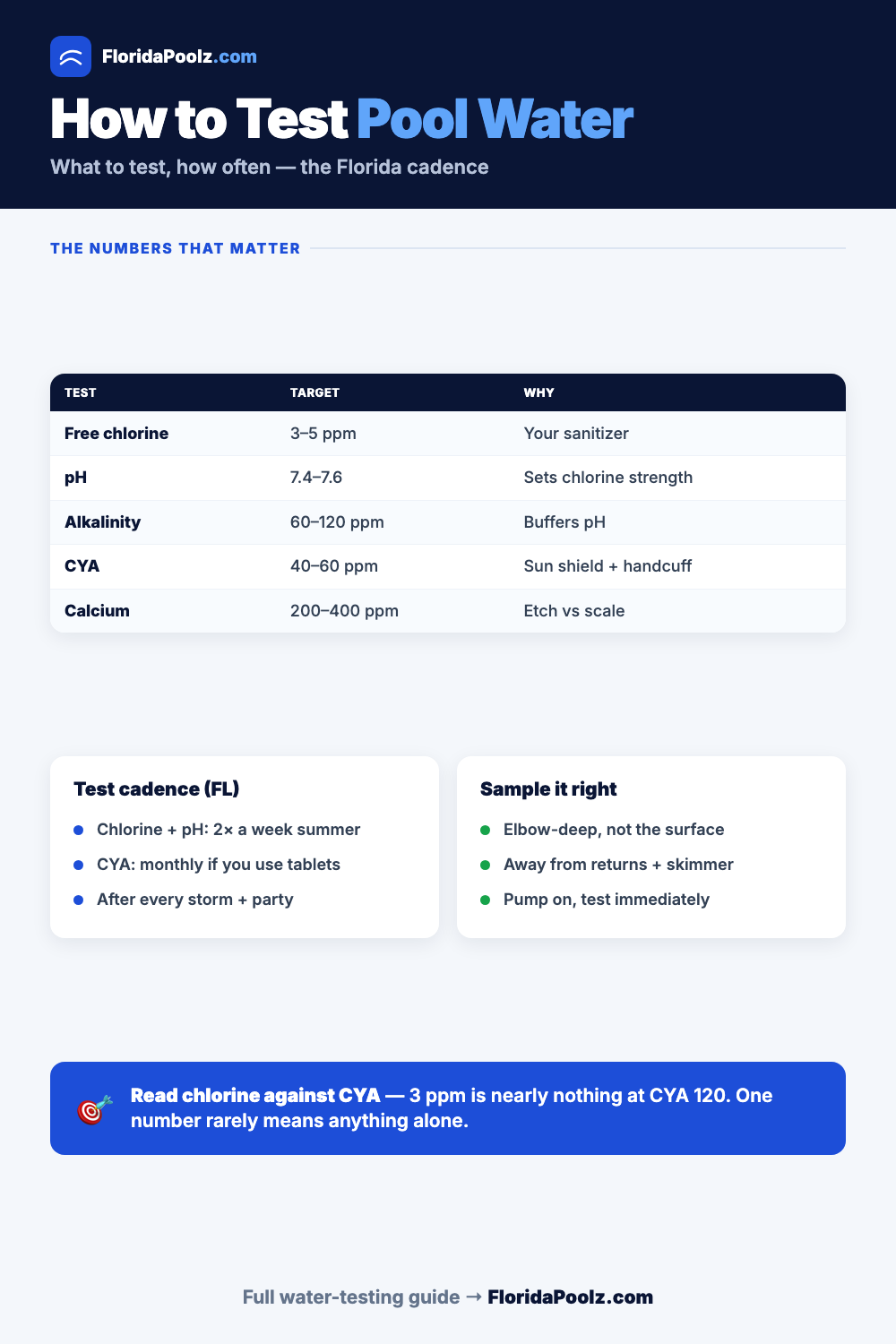
| What | Target range | Why it matters |
|---|---|---|
| Free chlorine | 3–5 ppm (FL summer) | Your sanitizer. Zero = algae by the weekend |
| pH | 7.4–7.6 | Sets how hard your chlorine works |
| Total alkalinity | 60–120 ppm | Buffers pH from swinging |
| Cyanuric acid (CYA) | 40–60 ppm | Sun protection for chlorine — and its handcuff if too high |
| Calcium hardness | 200–400 ppm | Too low etches plaster; too high scales + clouds |
| Salt (salt pools) | Per your cell (~3,200 ppm) | Low salt = the cell stops making chlorine |
Chlorine and pH are the weekly essentials. The others you check less often — but CYA is the one Florida owners most need to watch, because trichlor tablets drive it up all season until it quietly throttles your chlorine (the full story is in the cyanuric acid guide).
How often to test (the Florida cadence)
National advice is written for pools that close half the year. Florida’s arms race between chlorine and climate needs more:
- Free chlorine + pH: twice a week in summer, weekly in winter;
- Alkalinity: every couple of weeks, or whenever pH won’t hold still;
- CYA: monthly if you use any trichlor tablets, quarterly otherwise;
- Calcium: a few times a year, and before/after any big water change;
- After every storm and every pool party: chlorine and pH, same evening. Both events crash your numbers fast.
Strips vs drop kits vs digital: what to trust
| Method | Best for | The honest catch |
|---|---|---|
| Test strips | Fast weekly checks | Least precise; expire fast; misread in bad light |
| Liquid drop kit (e.g. Taylor K-2006) | Accurate home testing, the pro standard | Takes a few more minutes; learning curve |
| Digital tester | Easy reading, no color-matching | Costs more; needs calibration + fresh reagents |
| In-store testing | A second opinion, free | Only as good as your sample; upsell pressure |
The honest recommendation: keep strips for fast daily glances, but own one good drop kit for the readings that matter — especially when you’re fighting a problem, where strips top out right where the important numbers begin. A drop-based FAS-DPD chlorine test is the only way to read the high chlorine levels an algae fight needs.
The sampling mistake that ruins every reading
The most common reason a test lies has nothing to do with the kit. Where and how you take the sample decides the result:
- Sample elbow-deep, not from the surface — surface water is chemically unrepresentative;
- Away from the returns and the skimmer — right at a return jet you’re testing freshly dosed water, not the pool;
- With the pump running, so the water is mixed;
- Test immediately — a sample that sits, especially in the Florida sun, drifts before you read it.
Get the sample right and a cheap kit beats an expensive kit used carelessly.
How to read the results like a tech
Numbers only help if you know what they’re telling you together. A worked example of a struggling Florida pool:
- Free chlorine reads 3 ppm — “fine”? Not if CYA is 120. At that stabilizer level, 3 ppm is functionally almost nothing. Read chlorine against CYA, never alone;
- pH 8.2: whatever your chlorine number, it’s working at a fraction of its strength. Fix pH first, then re-judge everything;
- Alkalinity 30: pH will bounce all over until you raise it. That’s why your pH “won’t hold”;
- Calcium 550 + high pH: expect the white haze of calcium clouding.
Reading water is pattern recognition: one number rarely means anything; the combination tells the story. That’s the whole skill, and it comes fast with practice.
Testing a salt pool
Salt pools need everything above plus a salt reading — and here’s the trap: the control panel reports what the cell thinks the salt level is, not what’s actually in the water. As the cell ages, that estimate drifts. Test salt directly with strips or a meter, not by trusting the panel. A “low salt” warning on a pool that tests fine usually means the cell is aging, not that you need more salt.
DIY vs a monthly service
Testing yourself is cheap, fast, and teaches you your pool. But if the twice-weekly rhythm keeps slipping — vacations, busy summers, a pool you’d rather enjoy than manage — a weekly service handles testing and dosing as part of the visit, and catches problems before they bloom. It costs less than the chemicals for one green-to-clean recovery. Licensed Florida pool services are in the directory, and the rest of the routine is in our pool care guides.
FAQ
How often should I test my pool water in Florida?
Free chlorine and pH twice a week in summer, weekly in winter, plus after every storm and party. Alkalinity every couple of weeks, CYA monthly if you use tablets, calcium a few times a year. Florida’s year-round season needs more frequent testing than national advice assumes.
Are pool test strips accurate enough?
Fine for a fast weekly glance, not for solving problems — they’re the least precise method, expire quickly, and misread in poor light. Keep strips for convenience but own one good liquid drop kit (Taylor K-2006 is the pro standard) for readings that matter, especially during an algae fight.
Why do my pool test results seem wrong?
Usually the sample, not the kit. Test elbow-deep, away from returns and the skimmer, with the pump running, and read it immediately. A sample from the surface or next to a return jet — or one that sat in the sun — gives a misleading number.
What’s the most important pool number to test?
Free chlorine and pH weekly, but the one Florida owners overlook is cyanuric acid (CYA). It decides how much chlorine your pool actually needs, and trichlor tablets drive it up all season until it throttles your sanitizer. Always read chlorine against your CYA level.
Can I trust my salt pool’s panel for the salt reading?
No — the panel reports what the cell estimates, and that drifts as the cell ages. Test salt directly with strips or a meter. A “low salt” warning on a pool that tests fine usually signals an aging cell, not a real salt shortage.
References
More articles
How to Shock a Pool (the Right Way)
How to shock a pool the right way: which shock to use, how much, why to do it after sundown in Florida,…
The Pool Maintenance Schedule That Fits Florida
A Florida pool maintenance schedule that actually fits the climate: daily, weekly, monthly, and seasonal tasks, why our year-round season changes the…
How to Prepare Your Pool for a Hurricane in Florida
How to prepare a pool for a hurricane in Florida: the before-storm checklist, the drain mistake that wrecks pools, protecting equipment, and…