
Pool builders by city
Pool builders serving Port St. Lucie. This is a platted grid city, so most lots are the same shape and the rear setback does more of the deciding than the design does. Start with the shortlist, then read what your lot allows.
6 listings here 6 based here
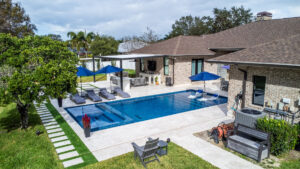
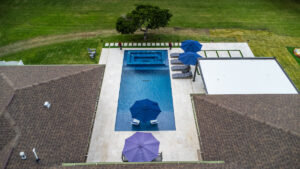
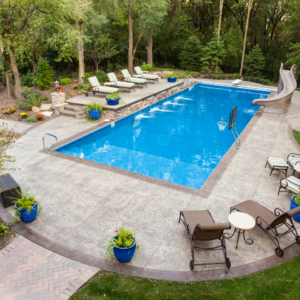


These pool builders are not based in Port St. Lucie and don't emphasize their services here, but they've shown they work here, too — so check them out, too!
Tell us what your dream pool is all about, and where do you want it. We'll do our best to find a professional pool builder for your project.
Under a dozen builders are based in the city, with a handful more covering it from elsewhere on the Treasure Coast. For a city that has grown as fast as this one, that is a working local trade rather than a thin field, and it shows in how routine the permitting is here.
Search “pool builders near me” from a Port St Lucie address and you will get companies from Stuart, Fort Pierce and Vero Beach alongside the local ones. They can all build here. What differs is how often they file with this particular building department, and on a platted grid where every lot is close to the same shape, that familiarity is worth more than it would be in a city of irregular lots.
Port St Lucie was laid out as a large planned subdivision rather than growing outward from a town centre, so the housing stock sits on a repeating grid of similar rectangular lots threaded by drainage canals. The practical effect is that pool design here is less about the shape of your land and more about a small number of fixed distances.
The one that binds most often is the rear. Under the city's supplementary use regulations, an accessory structure has to sit at least ten feet from the rear property line, with the side setback set by your zoning district rather than by a single citywide number. On a standard lot that pair of numbers, not the designer, decides how long the pool can be.
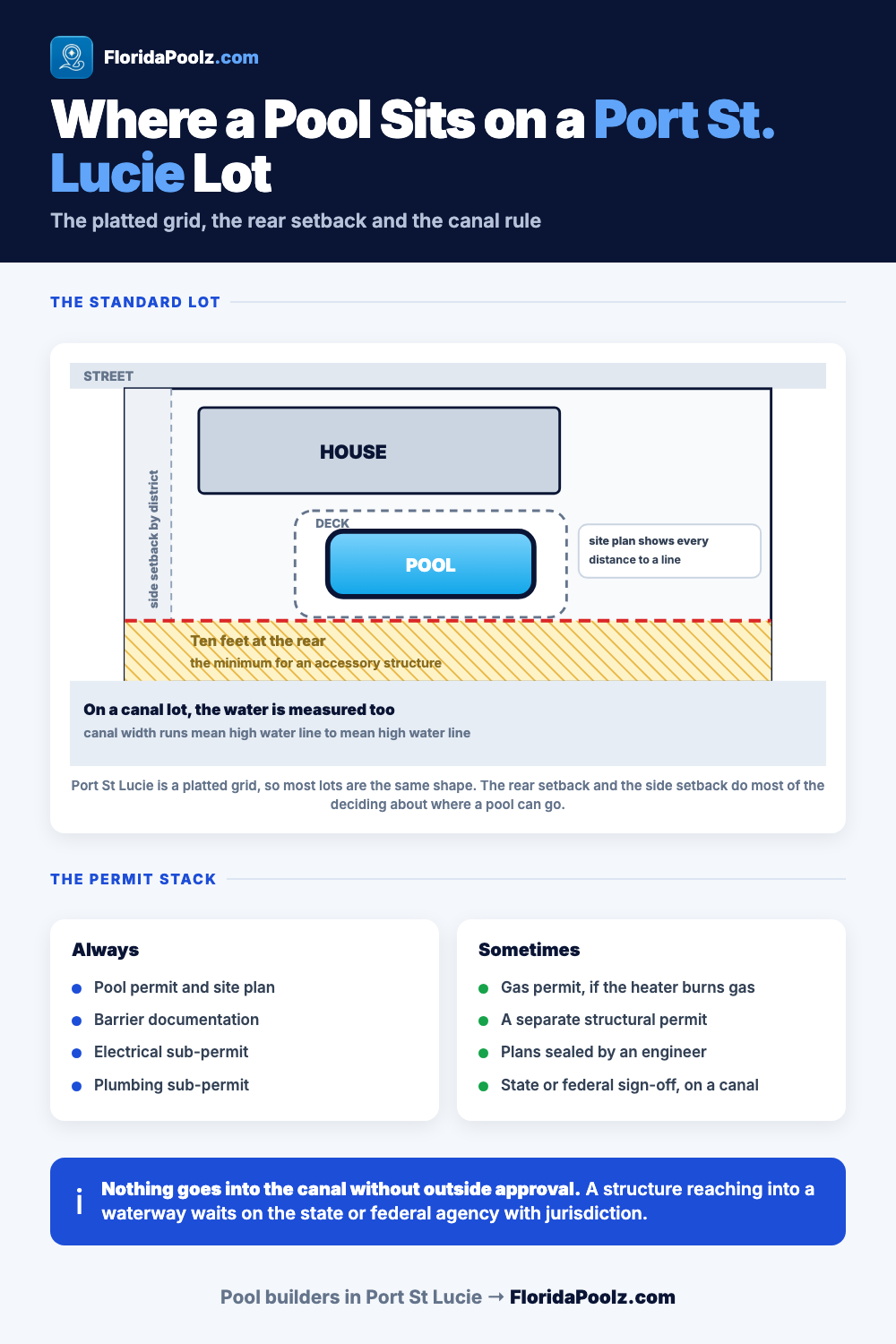
A great many lots here back onto water, and the code treats that boundary differently from a fence line. Canal width is measured from mean high water line to mean high water line, so the usable land stops before the water does in a way an aerial photograph will not show you.
The harder rule sits on top: no permit is issued for a structure built into a canal or waterway until it has been approved by whichever state or federal agency has jurisdiction. That is not a city timeline and the city cannot speed it up. If anything in your plan reaches past the bank, it belongs at the front of the schedule rather than at the end.
A pool here is not one application. The city wants the pool permit with barrier documentation and a site plan showing every distance to a property line, and around it:
The building department sits at 121 SW Port St Lucie Boulevard in Building B, and it keeps a shorter day on Wednesdays than the rest of the week. Small thing, but it is the sort of detail that costs somebody an afternoon.
Running it backwards is how a design gets drawn to a length the rear setback will not allow, then redrawn once the site plan is measured properly.
Because the lots repeat, quotes in this city separate on fewer things than they would in a market of mixed housing stock:
| Driver | What it does to the number |
|---|---|
| Shell type and finish | The biggest lever, as everywhere in Florida |
| How far the dig sits from the street | Machine time and truck movements |
| Gas heating | An extra permit and an extra trade |
| Sealed engineering | Required, and priced into the drawings |
| A canal boundary | Outside approval, and a longer calendar |
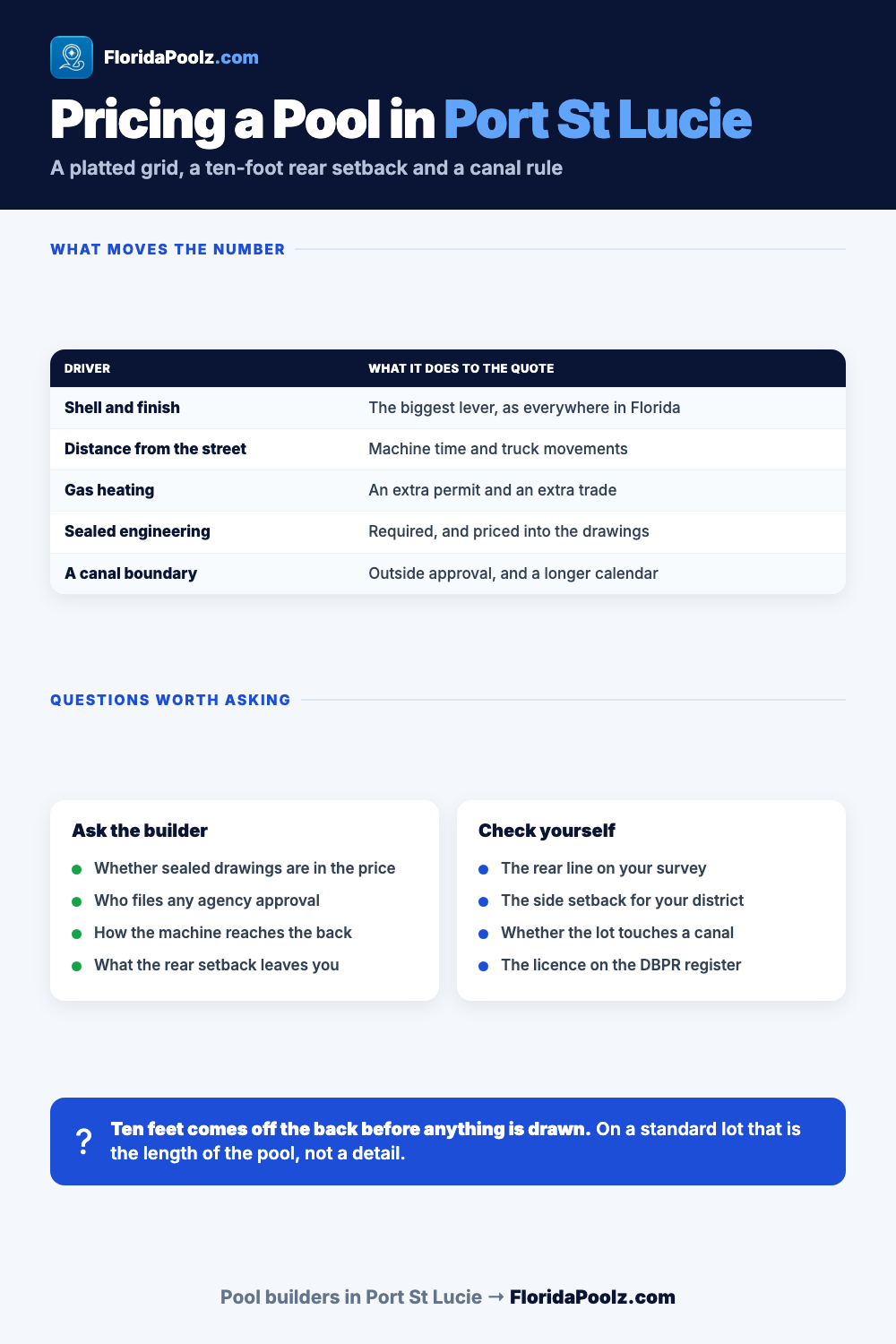
Measure the rear setback against your own survey before you let anyone draw a pool. Ten feet does not sound like much until it is taken off a lot that was already a standard depth, and the length of the shell is what gets shortened to find it.
The second thing, if the lot backs water: ask the builder plainly whether anything they are proposing touches the canal, and if so who is filing for the outside approval and when. A builder who has done this here will answer immediately. One who has not will tell you it is fine, and mean it, and then discover otherwise in about six weeks.
A standard grid lot rewards a plan that spends its money on usable surface rather than on shape.
The deck matters more than the outline of the shell, because on a lot this regular the deck is what makes the yard feel finished. A cage earns its place against the insects and the pine litter, and settling it early is what stops the deck being sized twice. Heating is a real decision this far up the coast, where the swimming season without it is meaningfully shorter than in Miami-Dade, and a spa gets used in the months the pool does not.
Lighting does the usual work after dark. What we would not put on a standard lot here is an infinity edge: it needs a grade change and a view, and a flat platted lot with a drainage canal behind it supplies neither.
Fort Pierce is north on older stock with a working waterfront and its own city department. Stuart sits in Martin County, so both the desk and the zoning change at the county line. Vero Beach is further north again, where the county division reviews for the city rather than the other way round — an arrangement that is rare in Florida and catches people out.
An accessory structure has to sit at least ten feet from the rear property line, with the side setback set by your zoning district rather than a single citywide figure. On the standard platted lot those two numbers decide the length of the shell, so measure them against your own survey before a designer starts.
The pool permit itself with barrier documentation and a site plan showing distances to every property line, plus an electrical sub-permit, a plumbing sub-permit and a separate structural permit. A gas permit is added where the heater burns propane or natural gas, and the plans have to be signed and sealed by a Florida-licensed engineer or architect.
Canal width is measured from mean high water line to mean high water line, so the land you can build on stops before the water does. More importantly, no permit is issued for a structure built into a canal or waterway until the state or federal agency with jurisdiction has approved it. That approval is outside the city's control, so it belongs at the start of the schedule.
Yes. Plans are signed and sealed by a Florida-licensed engineer or architect, which means the drawings are a professional deliverable rather than a sketch from a sales appointment. It is worth asking at quote stage whether the sealed drawings are included in the price or billed separately.
Shell type and finish first, then how far the dig sits from the street, whether the heater needs a gas permit, the sealed engineering, and whether the lot touches a canal. Because the lots here repeat, there are fewer site variables than in a mixed market, which makes line-by-line comparison unusually useful.
Look for an active Certified Pool/Spa Contractor license, or a Certified Building Contractor license whose scope reaches pools. Both are state-level and both are searchable on the DBPR register. Ten minutes there is the cheapest protection available on a five-figure job.
They measure different things. A “pool builders near me” pack ranks largely on how close a company is and how active its Google profile has been, so companies from Stuart, Fort Pierce and Vero Beach appear alongside the local ones. The ordering here comes from license standing, review history and the work each builder can show, which move far more slowly and say more about the build.
If you didn't find a pool builder for your Port St. Lucie passion project here, check out the neighbours: professional pool builders usually don't mind travelling a few miles to help new customers with the most exciting projects.