
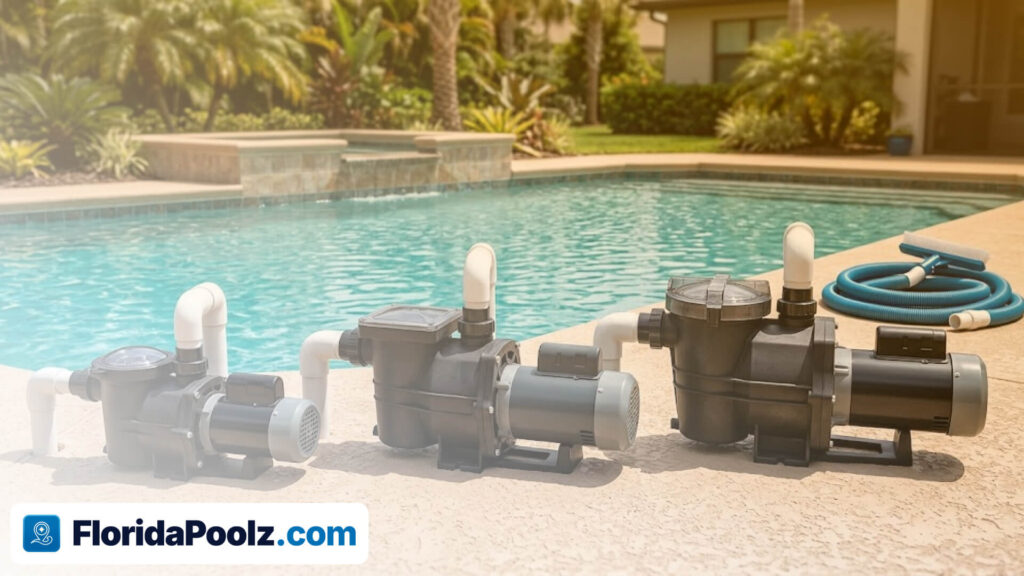
The instinct when buying a pool pump is to go big — and it’s the wrong instinct. An oversized pump costs more to run, is louder, wears your filter faster, and doesn’t clean the water any better. The right size moves your pool’s full volume through the filter in a reasonable time without overpowering the plumbing. This guide shows how to size a pool pump by volume and turnover, why bigger is usually a mistake, and why in Florida the real answer is almost always a variable-speed pump.
The two numbers that decide it
Pump sizing comes down to turnover: moving all your water through the filter in a target time (traditionally about 8 hours, though variable-speed changes the thinking). Two numbers set it:
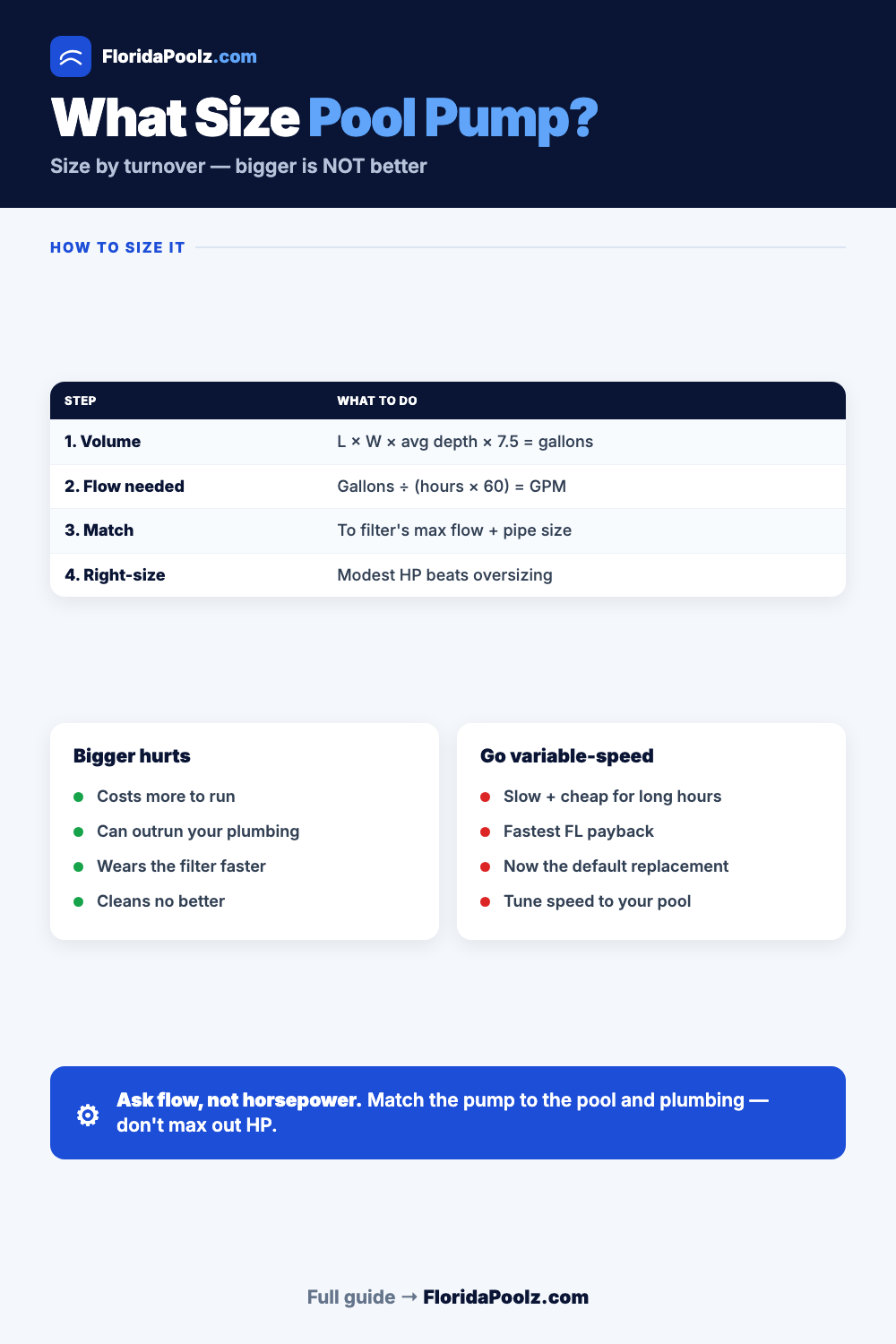
- Pool volume in gallons — length × width × average depth × 7.5 for a rough rectangle. A typical Florida inground is 12,000–18,000 gallons;
- Required flow rate — gallons per minute needed to turn that volume over in your target time. Volume ÷ (target hours × 60) = GPM.
Example: 15,000 gallons ÷ (8 hours × 60) ≈ 31 GPM to turn over in 8 hours. That’s the flow the pump needs to deliver through your actual plumbing — which is the catch below.
Why bigger is NOT better
The single most common pool-pump mistake is oversizing. Here’s why a too-big pump hurts:
- It costs more to run — a bigger motor draws more power for every hour it runs, and pool pumps run a lot in Florida;
- It can outrun your plumbing — pipes have a safe flow ceiling; push too much water and you get high pressure, strain, and even damage;
- It wears the filter faster — excessive flow forces debris deeper into the media and shortens its life;
- It’s louder and can pull air or cavitate if the plumbing can’t feed it;
- It doesn’t clean better — past the turnover your pool needs, extra horsepower is wasted money.
The pump should be matched to the pool and the plumbing, not maxed out. For most residential Florida pools that’s a modest horsepower — the “1.5 HP because more is better” reflex usually buys a bigger power bill for no benefit.
Match the pump to the filter and pipe
A pump doesn’t work alone — it has to suit the filter and plumbing:
- Filter flow rating — every filter has a max GPM; a pump that exceeds it pushes debris through and reduces filtration. Pump and filter should be balanced;
- Pipe diameter — 1.5″ vs 2″ plumbing caps how much water can safely move. An oversized pump on undersized pipe just makes noise and pressure;
- Feet of head — the resistance from pipe length, fittings, and the filter. A pump’s real delivered flow is always less than its box rating once head is figured in.
This is why “what HP” is the wrong first question. The right one is “what flow does my pool need, and what will my plumbing safely deliver?” — then pick the pump that hits that.
The variable-speed answer (and Florida law)
Here’s the modern reality that reframes the whole sizing question: a variable-speed pump (VSP) largely solves it. Instead of one fixed speed, a VSP dials its flow up or down — you run it slow most of the day (quiet, cheap, gentle on the filter) and speed up only for vacuuming or a feature. Because pump power drops sharply with speed, running a VSP slowly for long hours filters more water for less money than a single-speed’s short blast.
Two reasons this matters for sizing in Florida specifically. First, our year-round season means the pump runs constantly, so the energy savings of a VSP add up faster here than almost anywhere — the fastest payback in the country. Second, federal efficiency rules have effectively pushed most pump replacements to variable-speed, so when your single-speed dies, a VSP is likely what you’re buying anyway. The full run-time-and-cost picture is in our how long to run a pool pump guide. For sizing, a VSP takes the pressure off getting the horsepower exactly right — you tune the speed to your pool rather than living with one fixed flow.
Replacing an old pump: match or right-size down
If you’re swapping a dead pump, don’t just buy the same HP off the label — that pump may have been oversized to begin with. Note the pool volume, the filter’s flow rating, and the pipe size, and size to what the pool actually needs (often the same or less than the old unit). This is also the moment the VSP upgrade makes the most sense, since the plumbing and pad are already there. Homeowners can handle some of a pump swap, but the electrical connection needs a permit and, realistically, an electrician — pool equipment wiring near water is not a DIY corner to cut.
When to get a pro to size it
Sizing involves flow math, head-loss calculations, and matching three components — a licensed pool tech does it routinely and gets it right the first time, which saves you from a mis-bought pump. It’s worth a professional sizing when you’re replacing equipment, upgrading to variable-speed, or the current pump is loud, short-cycling, or can’t keep the pool clear. A right-sized VSP is one of the best returns in pool ownership: quieter, cheaper to run, and easier on everything downstream. Find licensed Florida pool equipment pros in the directory to size and install it.
FAQ
What size pool pump do I need for my pool?
Size by turnover: divide your pool’s gallons by (target hours × 60) to get the flow rate in GPM you need, then pick a pump that delivers that through your actual plumbing and filter. A typical 15,000-gallon Florida pool needs modest horsepower — most owners don’t need the big pump they assume they do.
Is a bigger pool pump better?
No — oversizing is the most common mistake. A too-big pump costs more to run, can exceed your pipe and filter’s safe flow, wears the filter faster, runs louder, and cleans no better past the turnover your pool needs. Match the pump to the pool and plumbing rather than maxing out horsepower.
Should I get a variable-speed pump?
In Florida, almost always yes. A variable-speed pump runs slow and cheap for long hours (filtering more for less money), and our year-round season gives it the fastest payback in the country. Federal efficiency rules have also made VSP the default replacement, so it’s likely what you’ll buy anyway.
Can I install a pool pump myself?
The plumbing side is within reach for a handy owner, but the electrical connection needs a permit and, realistically, an electrician — pool equipment wiring near water isn’t a safe DIY corner. If you’re only swapping like-for-like a pro is still worth it to confirm sizing and wiring.
How do I know my current pump is the wrong size?
Signs of an oversized pump: high filter pressure, loud operation, air or cavitation noise, and a big power bill. Signs of undersized or failing: the pool won’t clear, weak flow at the returns, or the pump straining. Either way, a professional sizing when you replace it fixes the root problem.
References
More articles
How to Clean a Pool Filter (Cartridge, Sand & DE)
How to clean a pool filter in Florida - cartridge, sand, and DE - when to do it, step by step, and…
How Long to Run a Pool Pump in Florida (the Real Answer)
How long to run a pool pump in Florida: 8-10 hours in summer for single-speed, near-continuous low RPM for variable-speed. The turnover…
DIY Pool Heating: What Actually Works (Ranked by Honest Math)
DIY pool heater reality check: solar covers and rings deliver real degrees for cheap, coil rigs mostly don't, and gas is never…