
A failing pool pump is the emergency at the heart of pool care, because the pump is what keeps the water moving, filtered, and chlorinated. Let it sit dead for a few summer days in Florida and you’re looking at a green pool on top of the repair bill. The good news is that a lot of pool pump repair is genuinely DIY-friendly once you can read the symptoms — and the parts that aren’t safe to touch are easy to draw a clean line around. This guide walks the common pump problems, what each one means, the fixes a handy owner can do, and the point where you stop and call a licensed pro.
First, read the symptom
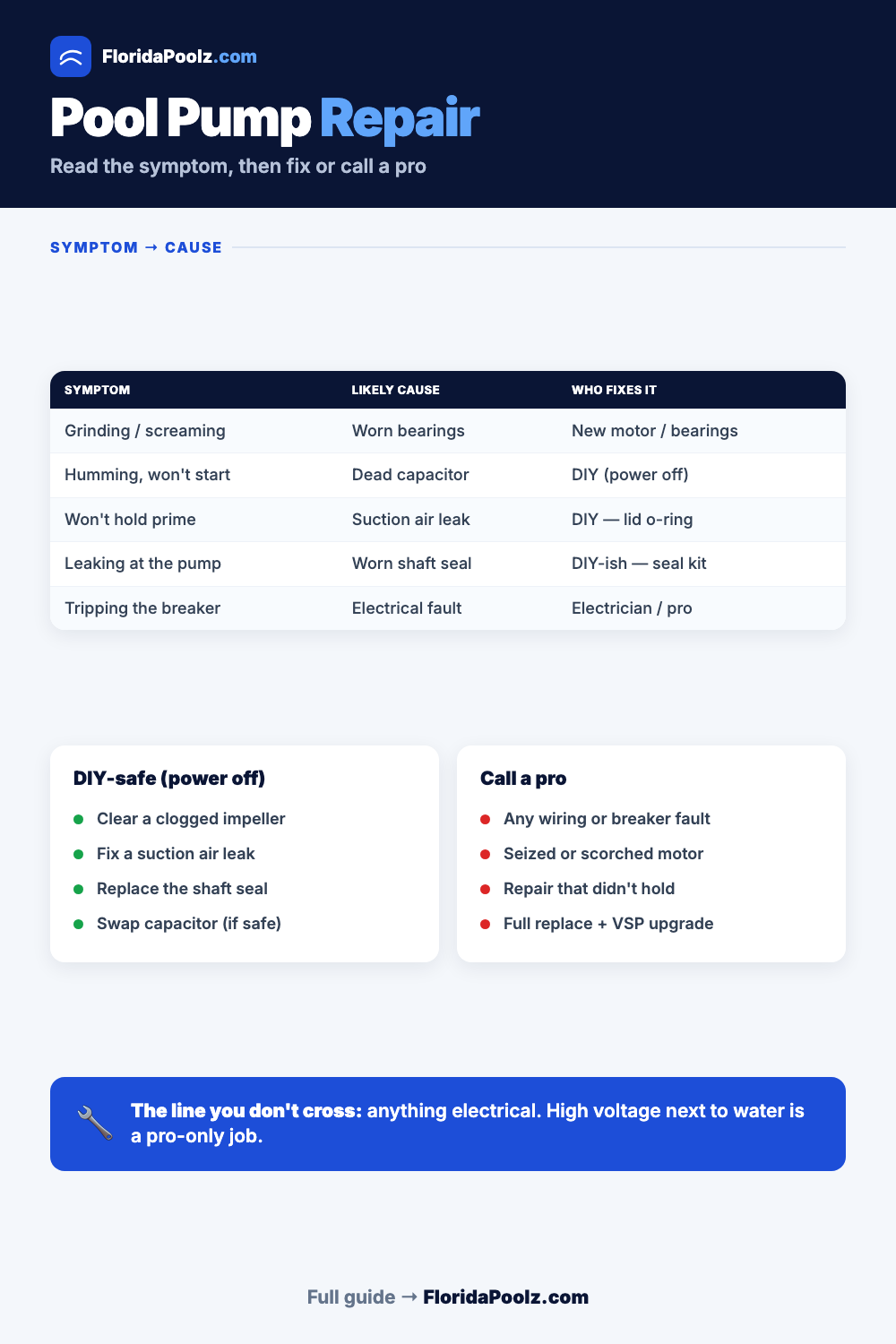
Pumps rarely die without warning. The sound it makes, or the way it fails, points straight at the problem:
| Symptom | Likely cause | Who fixes it |
|---|---|---|
| Loud grinding / screaming | Worn motor bearings | Bearing swap or new motor |
| Humming but won’t start | Failed capacitor | DIY-safe with power off |
| Won’t hold prime / air in basket | Suction-side air leak | Often DIY (lid o-ring, fittings) |
| Leaking water at the pump | Worn shaft seal or o-rings | DIY-ish; seal kit |
| Weak flow | Clogged impeller or basket | DIY clean-out |
| Tripping the breaker | Electrical fault / motor short | Electrician / pro |
The pump noises, decoded
Sound is the best free diagnostic you have. A screaming or grinding pump almost always means the motor bearings are worn out — the shaft is running dry of lubrication and metal is grinding on metal. Caught early, bearings can be replaced; left too long, they take the whole motor with them. A humming pump that won’t turn over usually points to a dead start capacitor — the motor’s “kick-starter.” And a rattling or sucking sound with bubbles in the pump basket is air getting into the suction side, which is a plumbing problem, not a motor one. Match the sound to the cause before you spend a dollar on parts.
The DIY-safe repairs
Clearing a clogged impeller
Weak flow with a clean filter often means debris jammed in the impeller — the spinning part that moves the water. With the power off, you can open the pump, reach in, and pull out the leaves or hair that clogged it. It’s one of the most satisfying quick fixes: flow returns instantly. Always cut power at the breaker first.
Fixing a suction-side air leak
If the pump won’t hold prime or you see air swirling in the basket, air is sneaking in on the suction side. The usual culprits are a dried-out pump lid o-ring, a loose lid, or a leaking fitting or valve on the intake plumbing. Lubricate or replace the lid o-ring, make sure the lid is snug, and check the fittings. This is the same problem behind a pump that loses its prime overnight, and it’s usually a cheap, satisfying fix.
Replacing the shaft seal (stopping a leak)
Water dripping from where the motor meets the wet end is typically a worn shaft seal. A shaft-seal kit is inexpensive, and replacing it is within reach of a mechanically comfortable owner — the job involves separating the motor from the pump housing, swapping the seal, and reassembling. Plenty of owners do it; if pulling the motor apart feels like too much, it’s a quick pro job.
Swapping a capacitor (carefully)
A humming pump that won’t start is often a dead capacitor, a common and cheap part. This repair is doable DIY only with the power fully off and the capacitor safely discharged — a charged capacitor holds a shock even when the power’s off. If you’re not confident discharging it safely, this one crosses into pro territory. When in doubt, don’t.
The line you don’t cross: electrical
Everything involving the pump’s wiring, the breaker, or a motor that trips the electrical is where DIY stops. Pool equipment runs on high-voltage circuits inches from water, and a wiring mistake here is a genuine electrocution and fire risk. A pump that trips the breaker, shows scorching, smells burnt, or has damaged wiring is a licensed electrician or pool tech’s job — full stop. No repair is worth the risk of getting this wrong.
Repair or replace?
The honest calculus: pool pumps have a finite life, and past a certain age, sinking money into repairs is throwing good money after bad. A useful rule of thumb — if the pump is well into its expected lifespan and the repair costs a large fraction of a new pump, replace it. Two Florida-specific factors push toward replacement:
- Year-round running wears pumps faster here than in seasonal climates, so an older Florida pump has logged more hours than its age suggests;
- The variable-speed upgrade — if you’re replacing a single-speed pump anyway, a variable-speed model pays for itself in energy savings and is the default replacement now (the case is in our pump sizing guide).
A repair that buys another season on a decade-old single-speed pump often makes less sense than upgrading to a VSP that cuts the power bill from day one.
Preventing the next repair
Most pump failures trace back to running conditions you can control. Keep the pump basket and skimmer clear so it isn’t straining against clogs. Don’t run a pump dry — a low water level that lets the pump suck air is hard on the seal and motor. Address air leaks and odd noises early, while they’re a cheap o-ring instead of a seized motor. And size and run the pump sensibly (an oversized pump run at full blast wears everything faster). Good habits here stretch a Florida pump’s life by years.
When to call a Florida pool tech
Call a pro when the problem is electrical, when the motor is seized or scorched, when a repair you attempted didn’t hold, or when the smart move is a full replacement and VSP upgrade you’d rather have installed correctly with the permit and wiring done right. A dead pump in a Florida summer is time-sensitive — the longer the water sits unfiltered, the closer you get to a green-pool recovery on top of the pump bill. Licensed Florida pool repair pros are in the directory, verified from state records.
FAQ
Why is my pool pump so loud?
A loud grinding or screaming pump almost always means worn motor bearings — the shaft running without lubrication, metal on metal. Caught early the bearings can be replaced; left too long they destroy the motor. A rattling sound with bubbles in the basket is different: that’s a suction-side air leak, a plumbing fix, not a motor one.
Can I repair a pool pump myself?
Many pump repairs are DIY-friendly with the power off: clearing a clogged impeller, fixing a suction air leak (lid o-ring, fittings), and replacing a shaft seal. A capacitor swap is doable only if you can safely discharge it. Anything involving wiring, the breaker, or a pump that trips the electrical is a licensed pro’s job.
Is it worth repairing an old pool pump?
If the pump is well into its expected life and the repair costs a large fraction of a new one, replace it — especially in Florida, where year-round running ages pumps faster. Replacing a dying single-speed pump is also the moment to upgrade to a variable-speed model that cuts your power bill from day one.
Why does my pool pump keep losing prime?
Losing prime means air is getting into the suction side — commonly a dried pump-lid o-ring, a loose lid, a low water level, or a leaking intake fitting. Check and lubricate the lid o-ring first, confirm the water level is above the skimmer, then inspect the suction plumbing for leaks.
My pool pump trips the breaker — what’s wrong?
A pump tripping the breaker signals an electrical fault — a shorted motor, damaged wiring, or a failing capacitor drawing too much current. This is not a DIY repair: high voltage next to water makes it an electrocution and fire risk. Leave the breaker off and call a licensed electrician or pool tech.
References
More articles

Pool Leak Detection: Find It Yourself Before You Pay Anyone
Pool leak detection starts free: the bucket test settles leak vs evaporation, dye finds the spot. Where Florida pools actually leak, and…

Next Level Pools and Spas: Success Story
Back in the 1980s, Robbie didn’t expect his future to be in any way connected to pools. He wanted to be a…
What Size Pool Pump Do I Need?
What size pool pump do I need? Size by pool volume and turnover, why bigger isn't better, the variable-speed rule, and Florida's…