
Pool builders by city
Pool builders serving Panama City. Bay County permits a pool, a cage, a roof and a demolition separately, and works from three wind-speed maps. Start with the shortlist, then read what the wind map does to a quote.
2 listings here 2 based here

These pool builders are not based in Panama City and don't emphasize their services here, but they've shown they work here, too — so check them out, too!
Tell us what your dream pool is all about, and where do you want it. We'll do our best to find a professional pool builder for your project.
A couple of builders are based here with one more covering the area, which is a small field by Florida standards and worth understanding before you start calling. The panhandle is a different market from the peninsula: fewer companies, longer drives between jobs, and a building stock still working through what Hurricane Michael did to it in 2018.
Search “pool builders near me” from a Panama City address and the results thin out fast. That makes the license check and the permit record more useful here than in a market where you can simply take a fourth quote.
Inside the city, the City of Panama City issues. Outside it, Bay County Building Safety does, through its own portal. What travels with the address regardless is the wind requirement.
Bay County works from three wind-speed maps sorted by structure risk category, and exterior components need current Florida Product Approval rated for the wind speed at your address. For a pool that reaches the cage, the equipment enclosure and anything else standing above the deck. It is the single most panhandle-specific thing about building here.
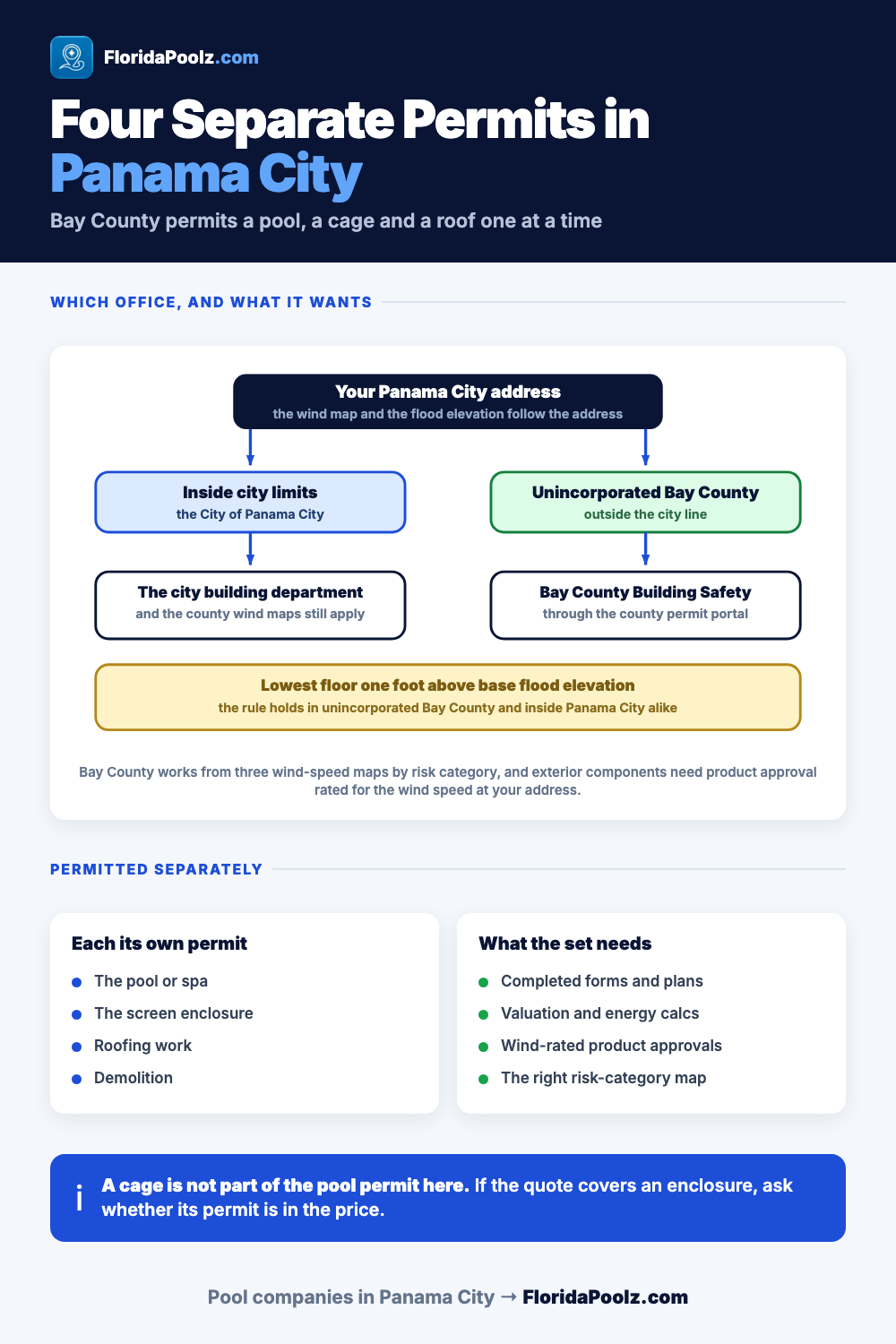
Bay County permits pools and spas, screen enclosures, roofing and demolition separately. That is not an administrative detail when a quote covers a pool and a cage, because it means two applications, two reviews and two sets of product approvals.
Ask directly whether the enclosure permit is inside the price you have been quoted. It is the most common gap in a panhandle pool contract.
In unincorporated Bay County and inside the City of Panama City alike, the lowest floor has to sit a foot above base flood elevation. For a house that is a familiar rule. For a pool project it shapes the deck, the equipment pad and anything enclosed that sits alongside the water.
The practical version: find your base flood elevation before design rather than during review, because it is a number the design has to work around rather than a box to tick afterwards.
| Driver | What it does to the number |
|---|---|
| Wind speed at the address | Product approval on everything exterior |
| Flood elevation | Shapes the deck and the equipment pad |
| Separate permits | Two applications where people assume one |
| Shell type and finish | The biggest single lever |
| A thin local field | Fewer quotes to compare than further south |
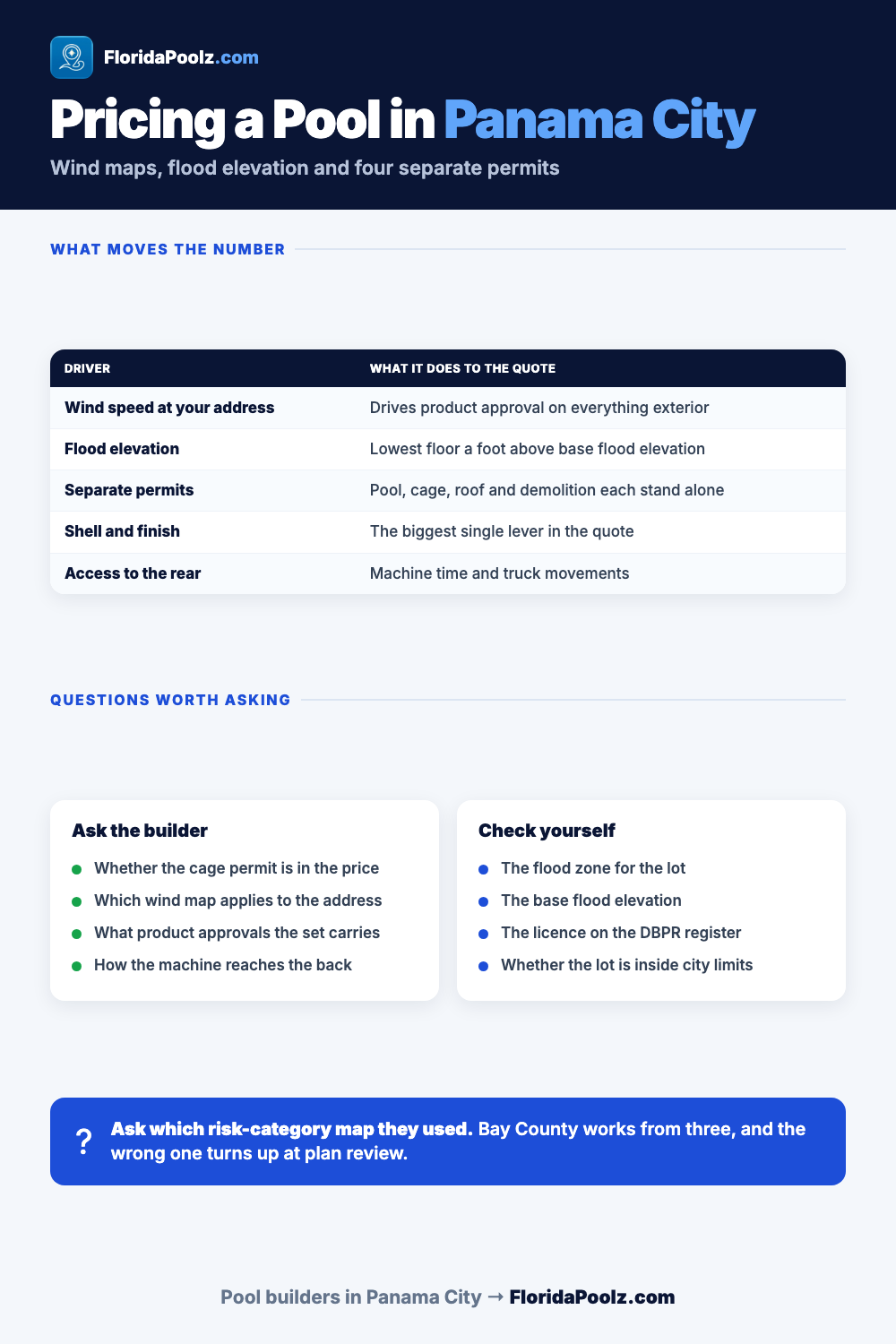
Ask which of the three risk-category wind maps the design was drawn against. It is a specific question with a specific answer, and it separates a company that builds here from one that adapted a set of drawings from somewhere else in Florida.
Then ask, plainly, whether the cage permit is in the price. Not the cage — the permit. In a county that issues them separately, that is where the misunderstanding lives.
The panhandle has a real winter, a serious wind requirement and a coastline that took a direct hit within living memory. All three point the same way.
Heating is close to essential this far north if you want more than a summer pool, and a spa extends that further into the cool months. A cage is an engineered structure here rather than a catalogue item, so if you want one, design it in from the start and price its permit separately.
The deck matters more than the shape of the shell on most lots here, and lighting does the usual work after dark. What we would think twice about is a large waterfall feature: it is more structure standing above the deck in a county that rates everything exterior against a wind map.
The panhandle is thin on comparable markets. Pensacola is about a hundred miles west in Escambia County, where the city runs its own department and the county reviews unincorporated land through a separate portal. Between the two there is no market of similar size, which is part of why the local field here is as small as it is.
The City of Panama City issues for addresses inside city limits, and Bay County Building Safety issues for unincorporated land through the county portal. The wind requirements and the flood elevation rule apply either way, so the office changes but the technical standards largely do not.
Bay County works from three wind-speed maps sorted by structure risk category, and exterior components need current Florida Product Approval rated for the wind speed at your address. For a pool that reaches the screen enclosure, the equipment enclosure and anything else standing above the deck. Ask which map a design was drawn against.
No. Bay County permits pools and spas, screen enclosures, roofing and demolition separately, so a pool and a cage are two applications and two reviews. If your quote includes an enclosure, ask specifically whether its permit is in the price, because this is the most common gap in a contract here.
In unincorporated Bay County and inside the City of Panama City, the lowest floor has to sit a foot above base flood elevation. For a pool project that shapes the deck, the equipment pad and any enclosed structure alongside the water. Find your base flood elevation before design rather than during review.
The wind speed at your address and the product approvals that follow from it, the flood elevation, whether the cage permit is included, and shell type and finish. With a smaller local field than South Florida, there are also fewer quotes to compare, which makes line-by-line reading more important rather than less.
There is no local credential to look for — pool contracting is licensed at state level, so the same license covers work in Panama City as anywhere in Florida. What matters is that it is active. The DBPR lookup will show you the status, any discipline on the record, and the insurance the state holds.
Proximity is doing most of the work in a “near me” result, and in a panhandle market that thins out quickly the results can include companies driving a long way. That is fine as a starting point. It just means the ordering reflects where an office happens to sit rather than what the company's license standing and review record look like, which is what this page ranks on.
If you didn't find a pool builder for your Panama City passion project here, check out the neighbours: professional pool builders usually don't mind travelling a few miles to help new customers with the most exciting projects.