
Pool builders by city
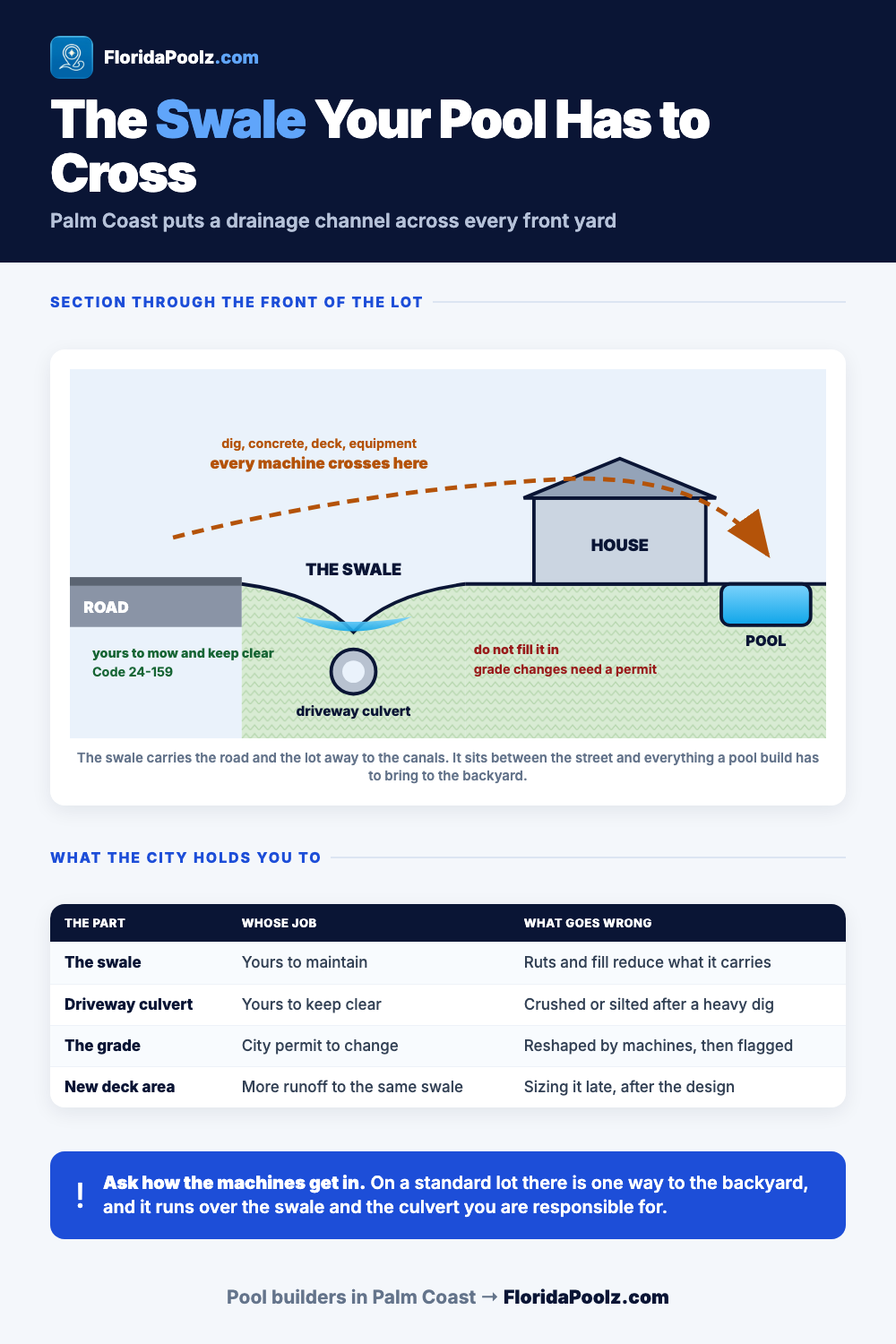
Pool builders serving Palm Coast. The thing that catches people out here is not the pool, it is the swale across the front of every lot: you maintain it, the city permits any change to it, and every machine on the job has to cross it. Start with the shortlist, then read what that means for your yard.
4 listings here 4 based here



These pool builders are not based in Palm Coast and don't emphasize their services here, but they've shown they work here, too — so check them out, too!
Tell us what your dream pool is all about, and where do you want it. We'll do our best to find a professional pool builder for your project.
Around ten are based in the city, with a couple more covering it from Flagler and northern Volusia. That is a real local trade for a city this size, and it exists because Palm Coast has been adding houses faster than almost anywhere in the state — the population is up by roughly a quarter since the 2020 census.
Search "pool builders near me" from a Palm Coast address and you will also get Daytona and St Augustine companies willing to drive. They can, and some are good. What a local outfit knows that a visitor sometimes does not is the thing sitting across the front of every lot in this city.
Palm Coast was laid out by ITT in 1969 with no kerbs and no storm sewers. Instead, a shallow grass channel runs across the front of each lot, connecting to the next one, carrying rainwater to the ditches and canals. Locals call it the swale, the city calls it the stormwater system, and it is the single biggest difference between building a pool here and building one two counties south.
Three things follow from it, and all three land on the homeowner.
The swale and the driveway culvert are yours to maintain under municipal code 24-159 — mowed, clear of debris, and open enough to keep water moving. Filling it in is not allowed, and anything that changes its grade needs a permit from the city. That includes damage, which matters here more than it sounds, because there is normally exactly one route from the street to your backyard and every machine on the job takes it.
An excavator, concrete trucks, a deck crew and the equipment pad all cross the same strip of grass and the same culvert pipe. Ask a builder how they intend to protect it, and what happens if it is rutted or crushed when they leave. A builder who works here every week will have an answer ready. It is a fair question and a revealing one.
The city is platted in lettered sections, and locals give directions by them. The F-Section is Palm Harbor, where ITT cut a twenty-three-mile saltwater canal network with access to the Intracoastal, and the lots there back onto navigable water with a seawall at the end of the yard rather than a fence.
A canal lot changes the job. The seawall is a structure with a service life, it belongs to the owner, and it needs the same back-of-lot access a pool build needs. Anywhere else in the city you are on a standard rectangular ITT lot with the swale at the front and neighbours close on both sides, and the constraint is access rather than water.
Worth knowing before you compare quotes: these are city lots without a homeowners association attached to the canal, so there is no architectural review committee between you and the permit. The rule layer is the city's, and that is the whole of it.
A pool here touches more than one department, and the city publishes a different number for each. Calling the right one first saves a week.
| Desk | What it owns | Number |
|---|---|---|
| Zoning | Setbacks, landscaping and aesthetic requirements | 386-986-3751 |
| Building | Permitting, plan review and inspections | 386-986-3780 |
| Construction Management and Engineering | Driveways, right of way and drainage | 386-986-3794 |
| Code Enforcement | Tree removal and wildfire mitigation | 386-986-3764 |
Trees are the one people get wrong. Palm Coast protects them under chapter 11 of its land development code, and a developed residential lot has a minimum tree density it has to keep. Removal approved as part of a building permit does not need a separate tree permit — but the density requirement does not go away, so a lot already at the minimum cannot simply lose two pines to make room for a pool. A pine within thirty feet of a structure, or closer to it than the tree is tall, can come out as a safety measure with a permit.
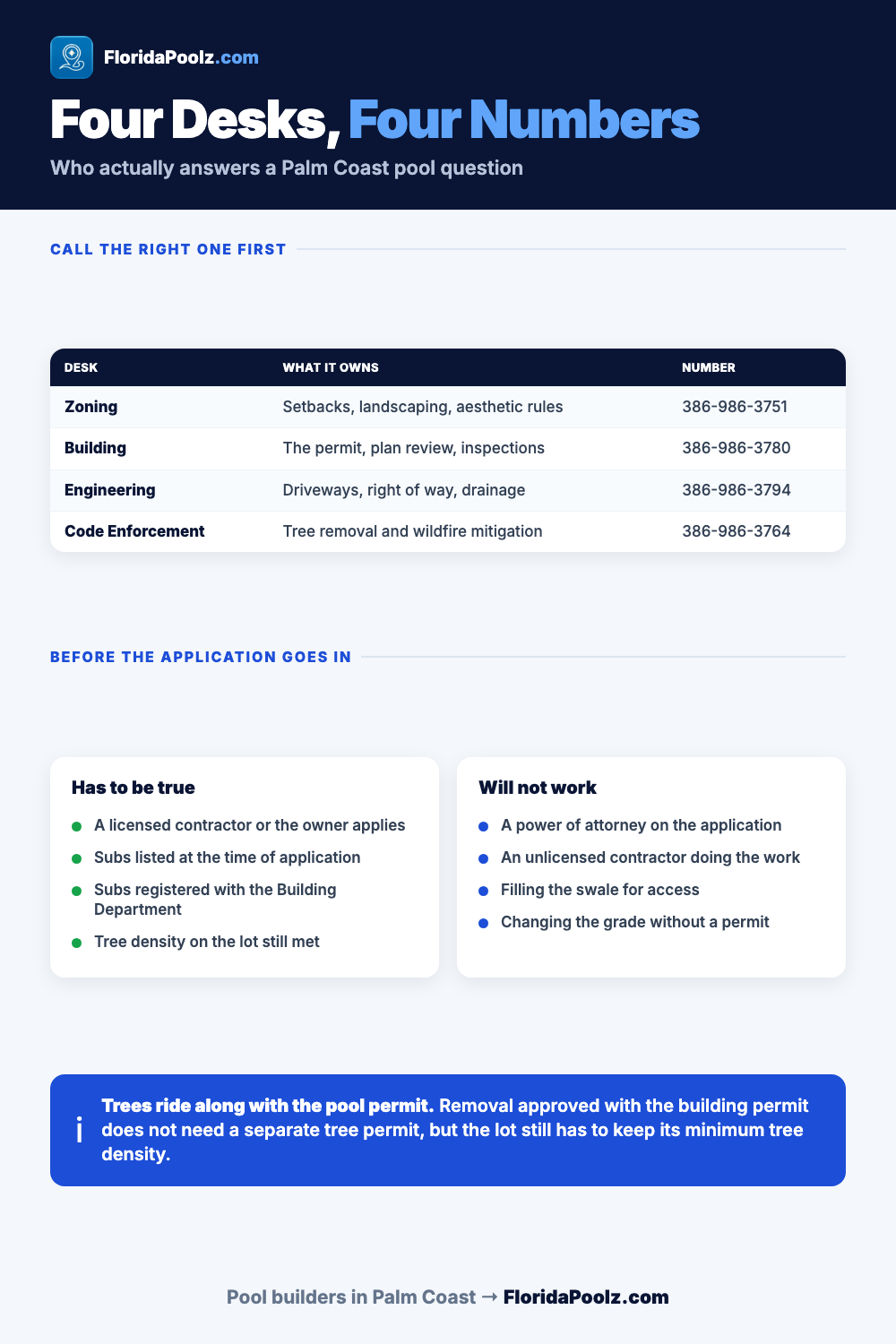
Palm Coast is stricter than most Florida cities about who files, and it is worth knowing before your contract is signed.
The application has to be signed by the licensed contractor or by the legal property owner. Powers of attorney are not accepted — a permit runner cannot sign it for either of you. The electrical, mechanical, plumbing and roofing subcontractors have to be named at the time of application, and every one of them has to be registered with the city's building department beforehand, which is a separate step from holding a state license.
If you file as an owner builder, the building has to be for your own use, and selling or leasing within a year of completion raises a presumption under Florida Statute 489.103(7) that you built it to sell. You also carry the workers' compensation obligation for anyone on your site. The city's own permit package is blunt about the other side of it too: hiring an unlicensed contractor exposes a homeowner to a five-thousand-dollar state fine for aiding and abetting.
Quotes here separate on fewer variables than in South Florida, because the lots are uniform and the ground is sand. The spread usually comes down to this:
The last one catches people moving from further south. Palm Coast sits about two hundred and fifty miles north of Miami, and an unheated pool here has a noticeably shorter usable season. A heater is a design decision made at quote stage, not an upgrade bought later, because it changes the equipment pad, the electrical load and sometimes the shell.
Get the access route agreed in writing before you sign anything. Not "we'll be careful" — the actual route, what goes down to protect the swale and the culvert, who inspects it afterwards, and who pays to put it right.
It is an unglamorous thing to negotiate and it is where the disputes are in this city. The pool itself is a fairly standard product on a fairly standard lot. The damage argument is about a strip of grass at the front that the city holds you responsible for, that a stranger's machinery drove over for six weeks, and that nobody photographed beforehand. Photograph it beforehand.
Heating is the first decision, not a luxury one. This is northern Florida and the water gets cold enough for long enough that an unheated pool sits unused for a chunk of the year. A spa earns its place for the same reason and gets used in months the pool does not.
After that the lot decides:
| Feature | Standard ITT lot | F-Section canal lot |
|---|---|---|
| Screen enclosure | Keeps the pine litter out | Weigh it against the water view |
| Deck | Size it against the swale | Runs to the seawall |
| Lighting | Does the work on a dark lot | Doubles on the canal behind |
| Sun shelf | Cheap depth to give up | Same, and it warms fastest |
A cage is worth more here than the brochures suggest, because these lots are wooded and pine needles find water. Lighting matters on streets with no kerbside lighting to borrow, and a sun shelf is the part of a cool-season pool that stays usable longest. On shell type, sandy ground and uniform lots make this a market where fiberglass competes properly with gunite rather than being the budget option.
The one thing we would size carefully rather than maximise is the deck. Every square foot of it is rainwater that used to soak into your lawn and now runs to the swale you are responsible for keeping clear. Big decks are not banned and plenty of people build them. Just decide the size on purpose, at design stage, rather than adding to it later.
Bunnell is the Flagler county seat next door, and outside the city limits the desk changes and so does the drainage picture, because the swale grid is a Palm Coast creation rather than a county one. St Augustine is half an hour north with a historic core where review is a different animal entirely. Ormond Beach is the nearest market of comparable size to the south, on older lots with mature oaks rather than an ITT grid.
It is the shallow grass channel running across the front of every Palm Coast lot, carrying rainwater to the ditches and canals in place of kerbs and storm drains. Under municipal code 24-159 you maintain the swale and the driveway culvert, filling it in is not allowed, and changing its grade needs a city permit. It matters for a pool because it sits between the street and your backyard, so every machine on the job crosses it.
You are, as far as the city is concerned — the maintenance obligation sits with the property owner. That is why the access route and making good afterwards belong in the contract rather than in a conversation. Photograph the swale and the culvert before work starts, and agree in writing who puts right any rutting or crushing.
Not usually. Where removal is approved as part of the building permit, a separate tree permit is not required and the trees are dealt with in that review. The catch is that a developed residential lot has to keep a minimum tree density under chapter 11 of the land development code, so a lot already sitting at the minimum cannot simply lose trees to make room. A pine within thirty feet of a structure, or closer than its own height, can be removed as a safety measure with a permit.
No. Palm Coast requires the application to be signed by the licensed contractor or the legal property owner, and powers of attorney are not accepted. The electrical, mechanical, plumbing and roofing subcontractors also have to be listed when you apply, and each has to be registered with the city's building department, which is separate from holding a state license.
It is not required, but this is northern Florida and the usable season without one is noticeably shorter than in the south of the state. Decide it at quote stage rather than later, because heating changes the equipment pad and the electrical load, and retrofitting is more expensive than including it. A spa alongside the pool is worth considering for the same reason.
The F-Section, Palm Harbor, sits on the twenty-three-mile saltwater canal network ITT cut with access to the Intracoastal, so the back of the lot is a seawall rather than a fence. The seawall is yours, it has a service life, and it needs the same access to the rear of the property that a pool build needs — which is a reason to establish its condition before the pool is designed rather than after.
Access down the side of the house, what it takes to protect the swale and culvert and put them right, trees coming out, heating, cage size, and the shell and finish. On a canal lot add the seawall. Ask for the access and swale protection to be priced as its own line, since it is the item that most often turns into an argument later.
Overlapping, not the same. A local pack result is weighted by proximity and Google Business Profile activity, so companies driving up from Daytona or down from St Augustine appear alongside Palm Coast firms. This page is built from license standing, review history and the work each builder can show. Either way, check the company on the DBPR license lookup for an active CPC, or a CBC whose scope covers pools, before any deposit.
If you didn't find a pool builder for your Palm Coast passion project here, check out the neighbours: professional pool builders usually don't mind travelling a few miles to help new customers with the most exciting projects.